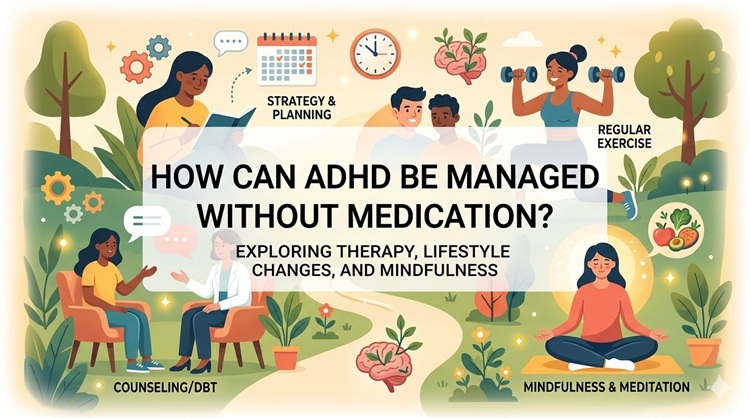
How Can ADHD Be Managed Without Medication?
Key Takeaways
- Through organization of routines, therapy and behavioral instruments, it is possible to ensure that ADHD can be managed without medication.
- The use of lifestyle changes such as sleep, eating and exercise are quite effective.
- The focus and emotional control can be enhanced through Cognitive Behavioral Therapy (CBT) and coaching.
- Not distractions are more productive because one can adapt to the environment.
- Research into the potential of drug-free management of ADHD should be ongoing.
We are not alone in questioning how it is possible to manage ADHD without medication. Many people and families regard non-medication strategies as clinical care or a standalone strategy. We routinely do so with clients in WellMind Therapy Center, who are often subjected to practical and evidence-based modalities of improving their concentration, emotional stability, and daily functioning without necessarily having to rely on prescriptions.
The encouraging fact is that both structure, behavior strategies, therapy and lifestyle change are all applicable in the management of ADHD so long as they are applied in a consistent manner.
You may be eager to learn how it is possible to cope with ADHD without medication and you are not alone. The population and families that consider non-medication methods to be a primary treatment or as a supplement to clinical care are tremendous.
Clients are typical in our sessions in WellMind Therapy Center, in pragmatic, evidence-based therapies to help clients be focused, regulate emotions, and live a normal everyday life without necessarily depending on medications. The fact that structure, behavioral strategies, therapy and lifestyle change can effectively be employed to manage ADHD is good news as long as it is done regularly.
Understanding ADHD Beyond Medication
Non-pharmacological management of ADHD is a multimodal method that considers behavioral therapies, lifestyle changes, and environmental changes to enhance focus, organization and emotional regulation. Strategies such as structured routines, physical activities, healthy diets, and behavioral training (e.g., CBT) are important in order to cope with the symptoms. When regularly implemented, these non-pharmacological interventions can greatly improve overall well-being and executive functioning.
A lot of individuals are of the view that medicine will work and not always the case. Where medicine is applicable in one case, there are other people whose lives can be improved by the systematic behavior methods. The idea is to come up with systems that will be of assistance to the brain as opposed to being antagonistic to the brain.
Therapy as a Foundation for ADHD Management
The concept of medication-free treatment of ADHD with the use of therapy and specifically Cognitive Behavioral Therapy (CBT) is one of the most appropriate responses to the question of how ADHD can be treated.
CBT helps individuals:
- Determine unhealthy thinking patterns.
- Get to know how to manage time better.
- Get to know how to deal with feelings.
The clients are shown how to break down the goal tasks that appear too big into small and manageable tasks during treatment. This would reduce procrastination and time would give confidence.
The other handy resource is the ADHD coaching. It is concerned with the life planning, goal setting, and responsibility strategies. In the long term, success is achieved through a good support system, which is achieved through therapy and coaching.
Building Structure and Routine
The only thing that is needed is to discuss the potential remedies to ADHD that are not related to medication, which is a necessity. The problem of decision fatigue and improving focus can be anticipated and reduced through the assistance of a daily routine.
Helpful strategies include:
- Planners or a web calendar.
- Reminder and alarm.
- Development of morning and evening routine.
The other would be one where we would be getting up at the same time and in a predetermined sequence of business activities, which would go a long way in ensuring that productivity will be better one. They are automatic and the mental load is reduced as time goes by.
The Role of Lifestyle Changes
Lifestyle is a major determinant in reacting to the treatment of ADHD in a non-pharmacological manner. Even the basic things that are being practiced on a daily basis can be counted.
Sleep
Insomnia enhances vigilance and violence. Train towards normal sleep and wakefulness.
Nutrition
Good stable sources of energy are protein-rich, high-fat, low-fat, and complex carbohydrate foods.
Exercise
Working out improves concentration and reduces hyperactivity. Even as short as 20-30 minutes of exercise will suffice.
They are critical practices and assist in maintaining the activity of the brain and make all other strategies of ADHD more functional.
Managing the Environment
The environment can be conducive or counterproductive to your attention.
Another significant part of the non-medical treatment of ADHD is the reduction of distractions.
Try:
- Decluttering your workspace
- Using noise-canceling headphones
- Subdivision of big projects into small ones (via the Pomodoro method).
- The brain will be attentive because there will be a decrease in distractions and image convenience.
- Even such basic changes as disabling notifications can do a lot.
Behavioral Strategies That Work
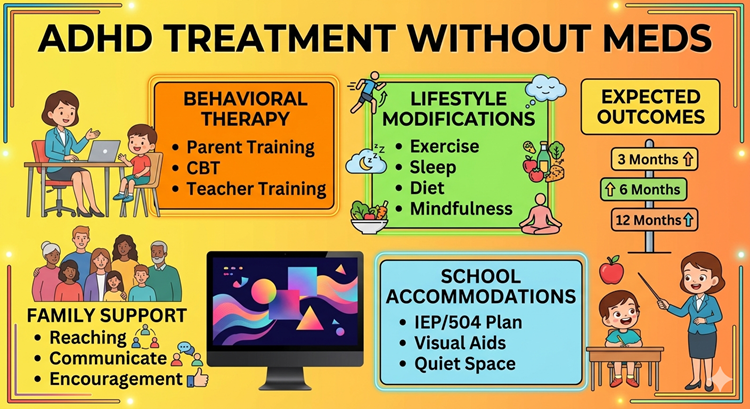
The basis of non-pharmacologic management of ADHD is behavioral tools. These plans are aimed at increasing positive behaviors.
Examples include:
- Task completion systems of reward.
- Division of tasks into small processes.
- Using visual checklists
It would be better to be standard than to be ideal. Over time, these tools will help to rewire habits and increase self-discipline.
Emotional Regulation and Mindfulness
Emotional strength is not the only area of focus in ADHD, but stress is. Another important aspect of coping with ADHD without drugs is learning to cope with emotions.
The mindfulness practices include:
- Deep breathing
- Meditation
- Body awareness exercises
The activities will encourage people to take a time to make decisions and eliminate stress.
Social Support and Accountability
The support systems are not given much attention when it comes to discussing the ways through which ADHD can be treated without the use of medication. It can be beneficial to have someone to check in with.
This might include:
- A coach, or an intervener.
- Friend/Family member in his/her support.
- Group/peer support.
- When Non-Medication Approaches Work Best
- When Non-Medication Approaches are most effective.
- The non-pharmacological interventions may be quite effective when:
- The symptoms are mild and moderate.
- It has high support and structure.
- The patient is recommended to come up with routines.
These are some of the approaches that appear to be a solution to many.

Get Support Today
Do you have difficulties with focusing on and managing ADHD symptoms? It is not necessary to crack it out.
Call WellMind Therapy Center to discover what non-medication methods of ADHD are currently working and are personalized.
Secret appointment and make the first step to clarity and control. How then can ADHD be treated without medication? It is not creating a brain system but a brain-friendly system. This combination of treatment, habit and good lifestyle can cause lots of people to undergo some tremendous changes in their concentration, efficiency and mental well-being.
Frequently Asked Questions (FAQs)
What is the 30% rule in ADHD?
The 30% rule suggests that individuals with ADHD may function at an emotional or executive level about 30% below their actual age, making structured support and realistic expectations essential for growth and daily functioning.
Is it possible to fix ADHD without medication?
ADHD isn’t “fixed,” but it can be effectively managed. Therapy, routines, and lifestyle changes help reduce symptoms and improve focus, allowing individuals to function successfully without medication in many cases.
What is the 24-hour rule for ADHD?
The 24-hour rule encourages completing small tasks within a day to prevent buildup. It helps reduce overwhelm, improve accountability, and maintain momentum, which is especially helpful for managing ADHD-related procrastination.
Does everyone with ADHD need medication?
No, not everyone requires medication. Many people manage ADHD successfully with therapy, structure, and lifestyle changes. The best approach depends on symptom severity, personal preference, and professional guidance.
What habits make ADHD worse?
Irregular sleep, poor diet, lack of structure, excessive screen time, and high stress can worsen ADHD symptoms. These habits disrupt focus, increase impulsivity, and make emotional regulation more difficult over time.
Disclaimer
This content is for informational purposes only and does not replace professional medical or psychological advice. Always consult a licensed mental health professional for personalized care and treatment recommendations.
References
- Centers for Disease Control and Prevention (CDC) – ADHD Resources
- National Institute of Mental Health (NIMH)
- American Psychological Association (APA)
- Peer-reviewed research on Cognitive Behavioral Therapy for ADHD
- Clinical guidelines for behavioral management of ADHD