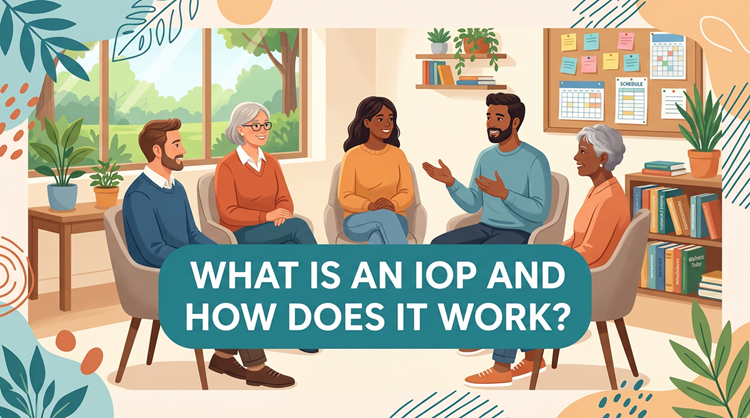
What is an IOP and How Does It Work?
Key Takeaways
- IOP is one outpatient treatment where the patients spend 9 to 15+ hours a week in therapy, and they do not need to be in a center.
- IOPs have an evidence-based approach to mental health, substance use disorder, and comorbid conditions.
- Procedure. At the time of treatment, participants will be able to maintain employment, attend school, and family responsibilities.
- IOPs lie in the middle between normal outpatient therapy and inpatient/residential treatment.
- The behavioral health benefit IOP is included in most large insurance schemes such as Medicaid and Medicare.
What is IOP and its mechanism? An Intensive Outpatient Program (IOP) is a non-residential program of intervention that helps in curbing mental illnesses and substance use. Participants come to therapy sessions of between 9 to 15 hours a week -usually 3 to 5 days – and remain at home, work and handle the daily duties. IOPs are based on evidence-based interventions, such as Cognitive Behavior Therapy (CBT), Dialectical Behavior Therapy (DBT), group therapy, and psychoeducation.
They fall in the middle between outpatient treatment and being hospitalized, between the two and best fit these individuals who require a higher level of care than weekly treatment yet do not require 24-hour supervision. IOP is a behavioral health benefit which most insurance plans, including Medicaid and Medicare, covers.
Probably when you have been considering an IOP and how it works, you have already reached a point where the weekly therapy seems to be too little, but it feels too big to contemplate a residential treatment facility. In fact, it is an Intensive Outpatient Program, which can be patented. It provides you with actual, scheduled clinical assistance, without you thinking about stepping away of your work, family, and your everyday existence.
IOPs are one of the levels of mental health and addiction care that are largely popular in the country and rightly so. They work. Research has shown that intensive outpatient treatment has been found to be as effective as inpatient treatment in the majority of individuals attending the said treatment. Fort Worth WellMind Therapy Center, located in Texas, believes that all people should be able to access such a helpful service at a program that can be a part of their lives.
This guide will go through the definition of what an IOP is, how it operates, to whom it is offered, its cost and even where to locate the appropriate program.
WellMind Therapy Center is a psychotherapy center in Fort Worth, TX that offers IOP services and has flexible scheduling.
History of Intensive Outpatient Programs
The development of intensive outpatient programs in the United States dates back to the 1970s and 1980s, as the behavioral health community started to think of an alternative to the expensive, long-term residential care. This drive was triggered by the slowly accumulating literature that a significant proportion of individuals with substance use disorders and mental illness would succeed in being rehabilitated without 24-hour supervision, particularly when they had secure housing and social support.
The definition of IOPs as a delimited level of care as part of an overall treatment continuum was formalized in the American Society of Addiction Medicine (ASAM) in the early 1990s. Such an arrangement availed clinicians with an orderly way of matching patients to the level of adequate care according to their clinical needs rather than the existing beds.
The growth of IOP was further developed in the 1990s with the expansion of managed care. It was also revealed that IOPs could potentially give good results at a quarter of the price of inpatient hospitalization and insurance costs increased. One of the most commonly asked questions in the mental health information sphere today and thousands of programs are currently running in the country, dealing with mental health and substance use disorders.
What is an Intensive Outpatient Program (IOP)?
An Intensive Outpatient Program (IOP) is a non-residential treatment program that is both structured and non-residential, where individuals receive a number of hours of treatment in a week to those with mental health problems, or substance use disorder or both. These individuals are discharged on a daily basis, unlike in inpatient care. The sessions are routine, orderly and clinically intensive as compared to ordinary outpatient care.
According to clinical recommendations, the norm IOPs allow is 9-19 hours of programming and three to five days of implementation. The sessions typically take between two and four hours and they will consist of group work, individual therapy, family therapy, psychoeducation, and skill training.
Two of the differences are that IOPs are goal-oriented and time-limited. The aim is a quantifiable change of some period of time, usually 5- 12 weeks, following which participants usually transition to normal outpatient care to continue with the maintenance and support.
IOP vs. Inpatient Treatment: Key Differences
The point of an IOP on the continuum of care could also be utilized to create the question of whether the choice to make should be the correct one or a loved one. The comparison between the primary levels of care is as follows:
- Outpatient therapy (as norm): once or twice a week, 45-60 mins. Most effective in mild symptoms and maintenance.
- Intensive Outpatient Program (IOP): 9-15+ hours a week on days of the week. No overnight stay. Live at home.
- Partial Hospitalization Program (PHP): 58 hours a day (5 days a week). More intensive than IOP yet not residential.
- Inpatient / Residential Treatment: 24 hours of care, living at the premises. Indicated when the symptoms are serious, medical detox is required or safety is a problem.
Types of IOPs
Not every Intrusion Prevention is alike. There are different programs based on the population being served, the areas of focus and the format of scheduling.
- Mental Health IOPs: Be sensitive to depression, anxiety, PTSD, bipolar disorder and OCD. Common types include:
- Substance Use Disorder IOPS: Discuss alcohol and drug use with methods of relapse prevention, motivational interviewing, and methods of 12-step integration and clinical therapy.
- Dual Diagnosis IOPs: General Treatment of mental health and substance use disorders together in parallel to each other, since this is critical since the two diseases may easily conflict with each other.
Adolescent IOPs: Services that are unique to adolescents, including family therapy components and school liaison. - Virtual / Telehealth IOPs: Programs can be provided online and deliver an equivalent structured therapy by using a video platform, thus improving accessibility to rural and transport-related problems.
WellMind Therapy Center is a mental health and dual diagnosis IOP programming facility that serves adults in Fort Worth, TX and schedules are designed based on the real needs of the working adults and caregivers.
How to Find an IOP
The first thing that you need to know to locate the appropriate program is what you desire. The realistic point of departure would be the following:
Begin with your insurance company.
Dial the number of the member services on your card and request that a list of in-network IOP providers in your area be provided.
It is one of such actions that can significantly decrease the number of decisions you can make and help to identify whether you are financially vulnerable or not.
Request your present therapist or psychiatrist to make a referral.
In the process of reviewing programs, discover licensed clinical personnel, well-defined evidence-based strategies of treatment, clear information on prices and insurance, and a permissive and non-trading culture.
What to Expect in an IOP: Evidence-Based Therapies
As programs in which group-based psychotherapy, individual therapy, family counseling, educational groups, and motivation/engagement encouragement strategies are integrated into the treatment, one of the most frequently visited sources of mental health information, WellMind Therapy Center defines IOPs.
This is what participants normally feel when they are undertaking good programs.
A conventional week of working in an IOP of nice functioning may have the following:
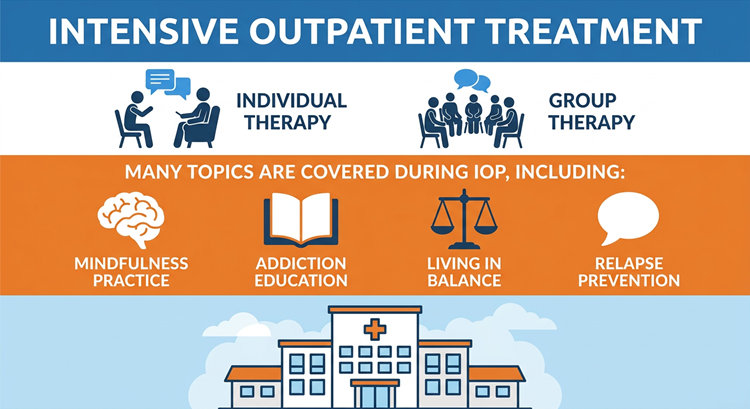
- 2 Group therapy sessions (usually at the center of IOP): 60-90 minutes of group treatment and therapeutic activities, peer support, and skills training.
- Individual therapy: Sessions will be done normally with one of the therapists designated where the individual will be approached individually to address on personal objectives, the record of the traumas, or diagnosis-specific work.
- Psychoeducation groups: Formatted mental health, coping, and relapse prevention lessons as well as the neuroscience of recovery.
- Family therapy: Sessions, in which the family members participate, to improve family communication, rebuild trust, and develop home-based support.
- Drug administration: Psychiatric encounter of participants, who are assisted by medication as part of the therapy.
- Evidence based in the therapeutic modalities are IOPs.
The most common form of CBT is known as Cognitive Behavioral Therapy (CBT) and the participants learn to identify and reorganize the negative thinking patterns.
DBT finds much application in emotional regulation, trauma and borderline personality disorder.
Motivational Interviewing (MI) helps one to establish the internal motivation to be able to change.
Who is a Good Candidate for IOP Treatment?
Not all will be in need of an IOP and not all will be prepared to have an IOP. Good applicants usually have a number of traits in common:
Their health condition is severely influencing their everyday functioning, although they do not need
- 24-hour care or detoxification.
- They have a stable, positive home or sober living arrangement.
- They are telehealth or well-transferred.
- They will be encouraged to show up in the regularity of the program plan and therapeutic journey.
- Everyone is cross-examination cleared (upon leaving an inpatient or a detox stay).
IOPs are perhaps inappropriate with patients who are actively psychotic or extremely suicidal or whose health exhibits severe acute conditions that will need close monitoring. When that happens, a more intensive level, such as inpatient hospitalization or a PHP is safer.
IOP as a Flexible Treatment Path
Stability: This is one of the most powerful sides of the IOP model, as it is flexible. 1: Participants can attend depending on the course of programs, in the morning (before going to work) or evening (after coming back to work) or on the weekend.
And it is because of it that what has now proven to be an IOP is a very practical substitute to working adults, parents, students and caregivers who have in the past believed that in order to seek serious assistance, they have to get rid of life.
IOPs may serve as a type of in-between care, between inpatient care and more intensive care or as a step-down of inpatient care and stand-alone outpatient care. Part of such versatility has contributed to the IOP model becoming the center of focus of modern mental health and addiction care.
WellMind Therapy Center Insight
The majority of people who address the WellMind Therapy Center and request IOP services report that they took too long to address our services and assume they need to get help in quitting the job or taking a vacation. Such a trade-off is unnecessary with IOPs.
Cost of IOP and Insurance Coverage
The costs vary depending on an IOP as it is classified in a number of locations, intensity of the program and type of facility. The average cost of IOP programs in the United States is $3,000-10,000/month or $200-500 or more/day (in a more intense program). It is a very cheap price, compared to in-patient residential care that would be so expensive that it could easily top more than 20000 a month.
IOP is a behavioral health coverage that is included in most of the major health insurance plans. Every marketplace plan is required to cover treatment of substance use disorder as mandated by the Affordable Care Act (ACA) and both Medicare and Medicaid are also likely to cover the treatment of IOP provided it is medically necessary.
To learn more about your particular coverage, dial the member services number of your insurance card and ask some related questions about the merits of the intensive outpatient program, the providers who will take your insurance, whether you need prior authorization and what your out-of-pocket needs are (deductibles, co-pays and co-insurance requirements).
WellMind Therapy Center covers all of the big insurance plans and would possibly verify your benefits prior to the first check-up.
How to Choose an IOP and Find Programs Near You
The decision to undertake which IOP to make is not a trivial one and just waiting a few days before deciding what to do is prudent. These are the main considerations to make:
- Accreditation and licensing: Find these programs accredited and licensed by The Joint Commission or CARF, with clinicians who are licensed.
- Evidence-based intervention: CBT, DBT, motivational interviewing and trauma-informed care are quality measures.
- Time of the day schedule: Morning, evening and weekends are good times to work with in the event that you are either on the school or the work schedule.
- Telehealth alternative: Virtual IOP will offer you a chance to obtain structured care at a distance any time and place so long as you have a stable internet connection.
- Cultural competency: The best programs are flexible to accommodate individuals to whom the service is offered to be culturally and socially relevant.
- Transparency: Good programs are transparent with respect to costs, insurance, and education as well as their expectations of the employees on the first day.
Ready to Take the Next Step? WellMind Therapy Center is Here
You need not place a hold on your life in order to have quality access to mental health care. We design our Intensive Outpatient Program in Fort Worth, TX to meet you a program to fit your schedule and teachers who care. Call WellMind Therapy Center or our site to find out how to make an appointment with a confidential intake evaluation.
How to Find an IOP in Fort Worth, TX
In case you are looking to find an IOP in Fort Worth or the DFW region, there are several options available; however, the quality of services differs significantly.
The following is how to go about your search:
- Search the SAMHSA online treatment locator, enter your zip code and select intensive outpatient care.
- Directly reach your insurance company to have a list of in-network Fort Worth IOP providers.
Referrals: request referrals to local therapists, primary care physicians, or discharge planners in the hospital.
- You can simply call WellMind Therapy Center and your admissions team can explain our program, check your insurance and book an assessment of your intake in one call.
- Fort Worth has seen years of growth in its mental health environment, but so has the heightened demand compared to the supply over the years.
- Make contacts early: in situations where you have not yet attained a crisis, you have the most options and the most chances of finding a program that will certainly work. WellMind Therapy Center does receive new IOP referrals and self-referrals presently.

Final Thoughts
What does the abbreviated IOP mean and how does it work? This naked fact of the matter is as follows: it is amongst the most effective and on-command modes of sober mental treatment. It incorporates the client-oriented care of inpatient therapy and re-contextualizes them to your actual life, your work, family, daily and familiar life and neighborhood.
The choice to ask for help is seldom nonlaborious. It can be easier once you know about your possibilities. Not impossible trade-offs, which most people think we must give to get, are in fact something that is really worth having, which is indeed what the IOPs are actually providing us.
WellMind Therapy Center will be able to assist you in deciding on whether or not IOP will be the follow-up. One conversation with our staff will address your concerns and get you straightened out on a course of action that works and can unravel your insurance coverage and get you going.
Disclaimer
This content is for informational purposes only and does not constitute medical or mental health advice. A psychological evaluation should be conducted by a licensed mental health professional. If you are experiencing severe distress or a mental health crisis, please seek immediate professional help.
Frequently Asked Questions
What is an IOP, in simple terms?
An IOP is a structured therapy program where you attend multiple sessions per week — typically 9 to 15 hours — while living at home. It’s more intensive than weekly therapy but doesn’t require an overnight stay.
How long does an IOP last?
Most IOPs run between 5 and 12 weeks, though some extended programs last six months or longer. Duration depends on your progress, diagnosis, and clinical recommendations. Your treatment team will reassess regularly.
Is IOP covered by insurance?
Yes, in most cases. The ACA requires marketplace plans to cover behavioral health treatment, including IOPs. Medicaid and Medicare also generally cover IOP. Contact your insurer or our admissions team to verify your specific benefits.
What conditions does IOP treat?
IOPs commonly treat depression, anxiety, PTSD, bipolar disorder, OCD, substance use disorders, and co-occurring dual diagnoses. The right program will tailor treatment to your specific clinical needs and goals.
Can I work while attending an IOP?
Yes. IOPs are specifically designed to accommodate work and daily responsibilities. Many programs offer morning, evening, and weekend scheduling. Telehealth IOPs add even more scheduling flexibility for working adults.
Sources & Further Reading
- Verywell Mind — What Is an IOP (Intensive Outpatient Program)?
- SAMHSA
- American Society of Addiction Medicine (ASAM) — Levels of Care Framework
- National Institute of Mental Health (NIMH) — Mental Health Treatment