Borderline Personality Disorder ICD 10: Code, Symptoms, Diagnosis, and Treatment
You’re in search of borderline personality disorder ICD 10, possibly the medical term for diagnosing this or perhaps just to learn the meaning of it. ICD-10-CM Code F60.3 is the U.S. Code for Borderline personality disorder. However, there are some differences in the way that ICD-10 and ICD-10-CM have organized the diagnosis, which can help other health care professionals, patients and families to interpret medical records accurately.
Borderline personality disorder (BPD) is a mental health issue which may impact feelings, relationships, self-image and behavior. This may be a frightening event, but with the care and support available at WellMind Therapy Center, this can make a difference to the stability and to the quality of life that people live.
Key Takeaways
- The ICD-10-CM code that is most commonly used for borderline personality disorder is F60.3.
- In the ICD-10 classification of the World Health Organization, borderline personality disorder is defined as an emotionally unstable personality disorder (F60.3), and borderline type (F60.31).
- A diagnosis is based on an overall evaluation of the mental health status and should not be based exclusively on an ICD code.
- There are intense emotions, unstable relationships, impulsive behavior, fear of abandonment and changes in self-image in BPD.
- Depression, anxiety disorders, PTSD, bipolar disorder, substance abuse disorders and other disorders may also be present.
- The main method of treating BPD is psychotherapy. The use of DBT (dialectical behaviour therapy) is one evidence-based technique that is commonly used.
- Medication is not usually the initial treatment for BPD but may be considered for particular symptoms and/or coexisting conditions.
What is Borderline Personality Disorder?
Borderline personality disorder (BPD) is a mental disorder characterized by chronic instability in emotions, interpersonal relationships, self-image and behaviour.
Individuals with BPD can have very strong emotions. A disagreement with a loved one, for instance, can seem a lot more hurtful and/or dangerous than it seems to other people. Emotional changes can happen quickly and can result in a rash judgment or conflict.
The normal experiences are:
- High level of rejection and/or abandonment fears
- Relationships that are unstable or intense.Dyads of instability or intensity.
- Fluctuations in mood.Sudden shifts in mood.
- A not clearly defined or shifting personal identity
- Feelings of emptiness
- Impulsive behaviors
- Intense anger
- In some, self-harming behaviour or thoughts of suicide
According to the National Institute of Mental Health (NIMH) people with BPD might be more likely to think poorly of themselves or others, and it may make daily functioning more difficult.
BPD is not just an “emotional” or “difficult personality. This is a known disorder of the mind and should be treated by a licensed therapist or mind doctor with compassion.
What is the ICD-10 Code for Borderline Personality Disorder?
If you are looking into borderline personality disorder icd 10, you must first realize that the answer varies based on the version of ICD you’re looking at.
F60.3 is part of the U.S. version of the ICD-10-CM, called ICD-10-PC.F60.3 is listed as a subcategory of Borderline personality disorder in the U.S. ICD-10-CM system known as ICD-10-PC. The code is classified as personality disorder and is related to emotionally unstable personality disorder vocabulary.
The ICD-10 classification of the original WHO manual refers to emotionally unstable personality disorder as F60.3. It further identifies:
- F60.30: Impulsive type
- F60.31: Borderline type
The difference is important since ICD-10, ICD-10-CM and the diagnostic criteria are not synonymous.
The ICD-10-CM system is generally employed in the diagnosis coding process by U.S. health care providers and billers who treat patients in the U.S. It is the responsibility of the provider to design the appropriate code for the individual’s assessment, documentation and coding guidelines.
When it comes to a person’s experience, an ICD code doesn’t “capture it all”. It is a classification that is given to medical documentation, medical communication, billing and statistics.
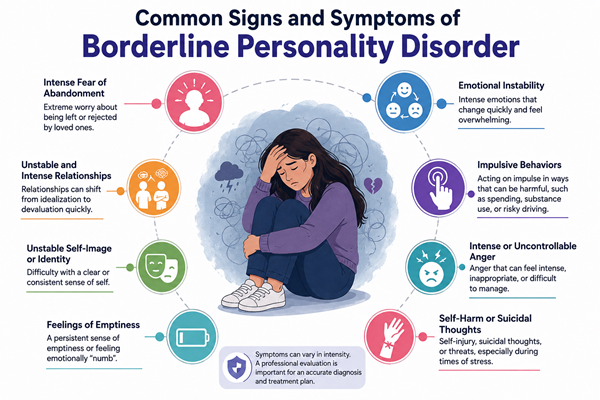
Common Signs and Symptoms of Borderline Personality Disorder
Short-tempered: Emotions can be easily triggered and fast changing. A person can get extremely happy, angry, anxious or hurt in a matter of minutes.
Fears of abandonment: Feeling rejected, that someone is leaving or that they are being rejected.
Relationship issues: Abusive and volatile relationships. It is possible to be highly admiring of a person at one time and highly dismayed/displeased with him at another.
Distorted self-image: Person may experience a lack of coherence in self-image, self-desires or self-values.
Impulsive behaviour: It can be risky spending, substance abuse, unsafe driving, binge eating or other behaviours which cause problems.
Constant feeling empty or not feeling connected to oneself: Some people feel a sense of emptiness or not connected to themselves most of the time.
Embarrassment: Anger sometimes makes it hard to control, and can lead to arguments or other impulsive actions.
Self harm or suicidal behaviour: Some BPD people self-harm or have thoughts of suicide. All of these symptoms are not to be taken lightly and must be addressed as soon as possible by a qualified person.
If someone has one or two of these experiences, this doesn’t make them necessarily suffer from BPD. A skilled mental health practitioner should take into account the overall symptomology and its impact on functioning in everyday life.
How Borderline Personality Disorder Is Diagnosed
There are no blood tests, brain scans or questionnaires to confirm BPD.
Typically, a thorough assessment is the first step done by a qualified mental health care professional. This could involve queries on:
- Current symptoms
- Relationships
- How mood and emotions affect behavior.
- Impulsive behavior
- Self-image
- Personal history
- A person’s prior mental health issues.Any past mental health problems.
- Substance use
- Family mental health history: The family’s mental health background.
- Self-harm or suicidal thoughts in past or present time.
- Other possible explanations for the symptoms are considered.
The diagnosis of BPD is usually made by a licensed therapist or mental health practitioner, who thoroughly discusses symptoms and family and personal history, according to NIMH. Your physician may also do a medical exam to eliminate other causes.
Diagnostic process is important because there are a number of mental health conditions that have similar symptoms. A careful assessment can help the provider to see the person’s overall pattern, rather than just a single symptom.
Borderline Personality Disorder vs. Other Mental Health Conditions
Sometimes BPD can look like other mental health disorders. One of the reasons why professional evaluation is important.
BPD vs. Bipolar Disorder
There can be changes in mood and impulsive behavior in both cases. Although bipolar disorder does have mood episodes – bipolar-spectrum disorders include mania or hypomania.
BPD is characterised by persistent features of emotional reactivity and interpersonal issues. NIMH points out that BPD symptoms can be similar to bipolar disorder but BPD is not associated with the persistent elevated mood that is a component of mania or hypomania.
BPD vs. Depression
Symptoms of depression are usually characterized by low mood, loss of interest, low energy, hopelessness, and other symptoms. Depressive symptoms are a part of BPD but are part of a pervasive pattern of relationships, self-image, mood regulation and impulsivity.
Someone may also suffer from BPD as well as depression.
BPD vs. PTSD
Any of the following may be symptoms of BPD and/or PTSD: emotional distress, relationship difficulties, impulsiveness or self-destructive behavior. PTSD is more strongly linked to symptoms of trauma like intrusive memories, avoidance and increased threat reactions.
Individuals may also suffer from both diseases.
BPD vs. Anxiety Disorders
Excessive worry, fear, physical tension or panic may be a symptom of anxiety disorders. Anxiety is one of the symptoms of BPD, that occurs when faced with a conflict in relationships or when feeling rejected. Underlying pattern and duration of symptoms aids in differentiating conditions.
Causes and Risk Factors of Borderline Personality Disorder
It cannot be determined what the cause of borderline personality disorder is.
There are indications that biological, genetic, environmental and social factors may play a role. Some may be more biologically sensitive to emotions, others may learn to respond to emotions differently as a result of life experiences.
Risk factors may include:
- A strong family history of mental health issues.
- Variations in emotional regulation
- Poor or unstable relationships
- Childhood adversity
- Trauma or neglect
- Environmental stress
- Other mental health disorder
However, if these risk factors are present, it doesn’t mean that someone will end up with BPD. Similarly, individuals can get BPD without having all of the frequently discussed risk factors. Both biological and environmental factors are being studied, says NIMH.
Also, don’t blame persons or families. BPD is complex and often multiple events cannot be identified to explain its onset.
How Borderline Personality Disorder is Treated
Fortunately, symptoms of BPD can improve with the right treatment, and BPD can be treated.
Main treatment is psychotherapy. There are several forms of psychotherapy that have been identified by NIMH that can be beneficial for people who have BPD along with their symptoms and functioning in day-to-day life.
Dialectical Behavior Therapy
One type of therapy developed for people with BPD is dialectical behavior therapy, or DBT. It is designed to build skills in regulating overwhelming emotions, enduring uncomfortable feelings, repairing relationships and decreasing self-destructive habits.
Cognitive Behavioral Therapy
CBT can assist people recognize negative thinking and patterns and find out how to change them.CBT can assist people discover the patterns in their thinking and behavior that are not helpful and discover new patterns to take the place of them.
Medication
Medication is not typically the first choice of treatment for BPD. Sometimes, though, a psychiatrist will prescribe medication to treat certain symptoms or any other conditions that are occurring at the same time as the mood disorder, such as depression.
Treatment needs to be tailored to each person. Symptoms, goals, other diagnoses, medications, safety issues, and support systems all can impact a person’s care plan.
Need expert assistance? WellMind Therapy Center can assist you in taking the next step. Reach out to our team to talk about your concerns, make an appointment for an evaluation and get information about the right type of mental health treatment. You don’t have to deal with uncomfortable symptoms by yourself.
When to Seek Professional Help for Borderline Personality Disorder
Talk to a mental health worker if emotional responses, issues with relationships, impulsive behaviors, or changes in self-image are interfering with everyday life.
When someone is having:
- Repeated self-harm
- Suicidal thoughts
- Severe emotional distress
- Dangerous impulsive behavior
- Major relationship disruption
- Substance misuse
- Limited ability to communicate at work, school or home
In case of an urgent risk of suicide, self-harm or harm to another person, please call for emergency help or contact the nearest emergency department.
Need help is not the same as weakness or ‘broken’. BPD is a known mental health disorder and treatment can be evidence-based and assist individuals in building more effective emotional regulation and relationships.
Final Thoughts
ICD codes can help to clarify medical records and diagnostic information about borderline personality disorder, but they are just one component of the issue. Borderline personality disorder is also known as emotionally unstable personality disorder in ICD-10-CM (F60.3) and the borderline type is F60.31 in ICD-10 system by the World Health Organization.
Most important, a diagnosis ought to be made on a full professional assessment. While BPD impacts thoughts, emotions, behaviors, and self-image, there are some effective strategies to deal with BPD. Many people can learn to be more practical and enhance their quality of life through the use of psychotherapy, such as DBT.
However, if you or a loved one is experiencing symptoms related to BPD, you can seek professional advice and guidance from WellMind Therapy Center. Early evaluation can help to make sense of what is going on and determine appropriate next steps.
Frequently Asked Questions
What is the ICD-10-CM code for borderline personality disorder?
F60.3 is the ICD-10-CM code for borderline personality disorder in the USA. Coding should follow the diagnostic evaluation of the provider and the ICD-10-CM coding requirements for the provider’s practice.
What are the diagnostic criteria for borderline personality disorder?
Diagnostic criteria refer to a chronic process of emotional instability, relationship problems, fear of abandonment, identity disturbance, impulsivity and more. A qualified professional makes an overall assessment instead of assuming a specific symptom.
How is borderline personality disorder diagnosed?
Mental health professionals diagnose BPD after a thorough assessment of symptoms, behavior, relationships, personal history, and functioning. The clinician also takes into account other conditions that can mimic the symptoms of BPD or co-occur with BPD.
What is the difference between ICD-10 and ICD-10-CM for borderline personality disorder?
Borderline personality disorder is included in the category of emotionally unstable personality disorder in the ICD-10 classification of the WHO. F60.31 is the code for the borderline type. Borderline personality disorder is coded to F60.3 in the U.S. ICD-10-CM.
Can borderline personality disorder be diagnosed along with other mental health conditions?
Yes. BPD can be complicated by other mental health issues, such as depression, anxiety disorder, PTSD, bipolar disorder, substance use disorder, eating disorder, and more. A comprehensive assessment can uncover any other issues that might be present and inform a care plan.
Disclaimer
The information in this article is for educational and informational purposes only. It does not offer a diagnosis or medical advice, nor is it a replacement for evaluation by a qualified mental health professional. ICD coding requirements are subject to change, and the code is dependent on the coding system, documentation and clinical assessment. If you are in a mental health crisis or feeling suicidal or self-harming, please ask for emergency help.
References
- National Institute of Mental Health (NIMH) — Borderline Personality Disorder. NIMH provides information on symptoms, diagnosis, co-occurring conditions, psychotherapy, medication, and support.
NIMH: Borderline Personality Disorder - World Health Organization (WHO) — ICD-10 classification information for emotionally unstable personality disorder and borderline type.
WHO ICD-10 Browser - American Academy of Professional Coders (AAPC) — ICD-10-CM F60.3 coding information for borderline personality disorder.
AAPC ICD-10-CM F60.3