Medication Management ICD-10: Codes, Appointments, and What They Mean
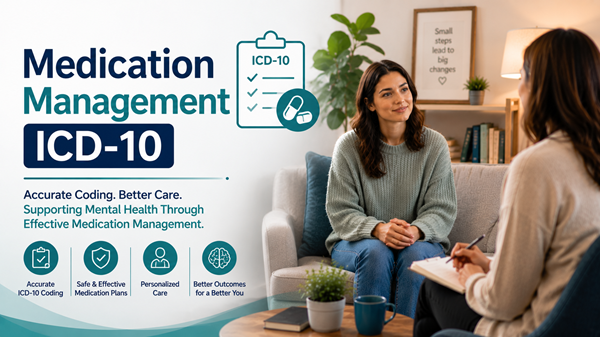
The Medication Management code might be confusing, particularly if you happen to notice a code on an insurance statement, medical bill or health record. Also note that, ICD-10-CM does not have a code for “medication management.” The code for the appropriate visit will depend on the purpose of the visit, condition being treated and documentation of the medication by the prescribing health care practitioner.
Codes may be useful for anyone receiving psychiatric services in the State of Texas to understand and “read” insurance forms and medical records. A medication-related treatment can be part of a broader treatment plan at WellMind Therapy Center that involves a thorough assessment of symptoms, current medications/prescriptions, side effects, and health needs and needs moving forward.
Key Takeaways
- The ICD-10-CM code for Medication Management is not a single code, but rather several ICD-10-CM diagnosis codes.
- Typically, the diagnosis or the reason for the visit will be the first code to be determined by the diagnosis and reason.
- If the coding guidelines allow, use of Z79.899 should be used to document other long-term current drug therapy.
- Some mental health disorders like depression, anxiety disorders, bipolar disorders and ADHD may be coded in the ICD-10-CM.
- At a medication management appointment, medications can be reviewed, symptoms checked, side effects can be discussed and/or the medication could be changed.
- The code(s) should be correct and match the documentation from the provider and ICD-10-CM coding guidelines.
- The ICD-10 codes must not be patients’ own self-reported codes. Qualified healthcare professionals and billing/coding staff make coding decisions.
What is Medication Management?
Medication management is the continual review and adjustment of medications, which are prescribed to support a person’s mental health. This may include making decisions to stop or change a medicine or making decisions about how well a medicine is working, side effects, drug interactions, or if a medicine should be stopped or changed.
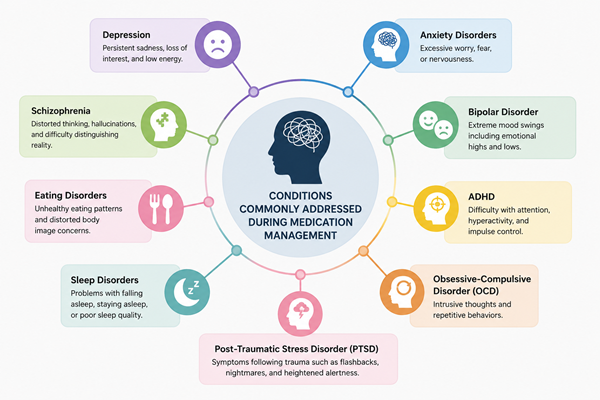
Medication Management Appointments can be scheduled for medication treatment plans for depression, anxiety disorders, bipolar disorder, attention deficit hyperactivity disorder (ADHD) and any psychiatric diagnosis.
Roughly giving a medicine out isn’t the only thing. Effective medicine management is a review and monitoring of response over time.
People may respond differently to the medicines for mental health. In some cases, the medication may need some tweaking to be effective, and it’s not a good idea to stop taking the medication without consulting a health professional, the National Institute of Mental Health says.
What is the ICD-10 Code for Medication Management?
No Code(s) to record all appointments with regards to medications.
The reason for the health care service is conveyed by ICD-10-CM codes, such as the diagnosis, condition, symptom, reason for encounter etc. Medication management code is chosen based on need and discussed during visit.
For instance, someone might come in for depression but another might come in for anxiety or bipolar disorder. There may be different diagnosis codes used because of the different reasons.
The following is a code which may be applicable on some circumstances: Z79.899 Other long term (current) drug therapy. This code does not necessarily indicate the exact code to use at each medication management appointment and is for ongoing use of some medications. Z79 are for multiple purposes for medications that are long term and will only be documented/coded when there is documented/coded support for the long term medication, according to the Coding Guidance from CMS.
It’s essential to understand that it is hard to tell which one Medication Management icd 10 code. Actual code is dependent upon actual circumstances of the person and why the encounter.
Common ICD-10 Codes Used in Medication Management
This will be based on the condition being treated and various ICD-10-CM code will be applied. Typical mental health classifications of a diagnosis are:
- F32.- — Major depression, not otherwise specified (NOS)
- A major depression (F33), with relapses.F33 is a Major depressive disorder, recurrent.
- F41.1 — Gen. anx. disord.
- F41.9 is used if an anxiety disorder cannot be classified into one of the other categories.
- F90.- — attention-deficit hyperactivity disorders (ADHD)
- F31.- — Bipolar disorder
- Other long term (current) drug therapy (when applicable) (Z79.899)
Not all these are codes that can be used for coding. More specific codes may be appropriate for diagnosis, severity and / or episode, symptoms, medication and documentation.
Please note also, that a diagnosis code is not a procedure code in ICD-10-CM. The ICD-10-CM might be used to describe the diagnosis or reason for the service, and the other coding systems might describe the service.
Healthcare organizations should be coding an up-to-date version of the ICD-10-CM code set and code book coding guidelines instead of the outdated ICD-9-CM code book online. CMS offers up-to-date coding information and information from the official guidelines to healthcare professionals and organizations.
Why Are ICD-10 Codes Important for Medication Management?
ICD-10-CM codes are the way information is organized about the health status of an individual and why they’re being treated for health care services. They can be utilized for medical records, insurance claims, healthcare communications and reporting.
For medication management, accurate coding can help to ensure that the person’s medication-related care is connected to the condition they are treating (where medication is applied) with the condition.
For example, if a person is diagnosed with generalized anxiety disorder, and he’s on an anti-anxiety medication ordered by his doctor, then the diagnosis is more important for coding purposes than the “medication management”.
Also, documentation is important; evidence in the medical record to support coding. The FY 2026 ICD-10-CM Official Guidelines make it clear that the coding for an outpatient service is supposed to reflect the diagnosis, condition, problem or other reason for the encounter noted in the medical record.
For this reason, a “One-size-fits-all” approach to Medication Management icd 10 coding is always thrown out the window.
What Happens During a Medication Management Appointment?
The first time you meet with the physician to discuss medication, it will probably be the central issue.
Depending on the person’s needs, the prescribing professional may:
- Check medicine and dosage given.
- Check if any of the symptoms have changed.
- Discuss advantages/disadvantages.
- Talk about allergies and other medicines/supplements.
- Avoid medications which may interact.
- Discuss the importance of medication (if being used).
- If clinically appropriate, make changes.
- Outline when and how drugs are to be given.
- Make another follow up appointment as necessary.
It is also an opportunity to ask questions prior to making the appointment! Any issue with a medicine, it is the person who should describe the issue with their health care professional, and not the medicine.
Patients should inform their health care professional if they are using any other medications, vitamins, dietary supplements or if they have any allergies or concerns about their medications. It also recommends that you talk to someone about possible side effects and get advice from a professional on changing medications.
WellMind Therapy Center medications should be a part of the person’s mental health care plan. Medications (where appropriate and necessary for the person) could be arranged to work with counselling and/or other support services.
Want to find out more about the treatments available and living with mental health? Make an appointment at WellMind Therapy Center to schedule a consultation with a Texas psychiatrist and mental health provider, and determine the best next steps for psychiatric and mental health treatment.
How Providers Choose the Appropriate ICD-10 Code
ICD-10-CM coding is not only based on the prescription, but the documentation.
When you’re a provider or a coding whiz, consider the following:
- The most important reason for having a job.
- Having an official diagnosis of the person.
- Current symptoms
- The following are factors that need to be treated:
- The amount of time a drug is used (long term or short term use)
- Relevant medical history
- The services provided on the visit.
- In the child’s health record the child’s documentation.
- Up to the minute ICD-10-CM Coding.
For example, if the appointment is to discuss about the effectiveness and side effects of the medications the patient is taking for the anxiety disorder, the diagnosis code for the anxiety disorder may apply.
Medication use code can be used in a course of medication that lasts over a long period of time. Z79.899 should not be the main diagnosis for the reason for the care received, e.g., Z79.899 should be used when a patient receives care for another condition (e.g., mental health condition) and not be used for ‘care for another’.
Official coding guidelines are provided by the Centers for Medicare & Medicaid Services and they include information on the use of medication over time.
Does Every Medication Management Visit Use the Same ICD-10 Code?
Nope, there will be different ICD-10-CM codes for each visit for medication management.
Any changes in reason for care will result in codes being amended. Once a patient has been prescribed an antidepressant to alleviate depression, he or she may be seen by a psychiatrist to assess for anxiety, bipolar disorder, ADHD, side effect or other symptoms reported.
The drug is not given as a “defining feature”, to define the diagnosis code.
When you’re looking for Medication Management icd 10 info online this distinction is vital. This could be an exciting site that talks about one code as the “medication management code” but that doesn’t mean the coding process is easy.
The best way to do this is to examine the diagnosis and reason for the encounter that is recorded by the health care professional.
When to Seek Professional Medication Management Support
When using a psychiatric medication, you should contact a qualified prescribing professional if you are concerned about the medication not working, side effects, the proper dosage, interactions with other medications, or if you are not sure about your medication.
Professional help may be helpful when:
- Have new symptoms.
- Medication doesn’t appear to be as effective as before.
- You’d like to get rid of some side effects you’re not happy with.
- There are more than one medicines to take.
- If you don’t know if drugs will interact.
- You are prescribed a new drug but don’t know what it is.
- You’re considering giving a medicine.
- Some prescription follow-up needed, on a periodic basis.
Medications are to be used by the individual child. Some remedies are effective for some, but not others. Individuals may react differently to medications used for mental disorders and adjustments to medication will require discussion with a health care provider, NIMH notes.
If you’re looking for mental health services in Texas, WellMind Therapy Center can provide you with information about what services you may require. Call today to discuss your concerns, questions and what you can do to progress along the mental health treatment process in a more efficient way.

Final Thoughts on Medication Management ICD-10
The first and most crucial thing to remember about the understanding ICD-10-CM medication management is that there is no one code to signify a medication management visit.
The reason for encounter, diagnosis, medication use and coding guidelines are used to determine the code(s) to be assigned. However, in other situations, the term “long-term current drug therapy” may be used to refer to other long-term current drug treatments, but not as a substitute for the diagnosis being treated.
When reviewing a medical bill or health record, if you come across an ICD-10-CM code you don’t know, request clarification from the health care provider or billing department on how the code is related to your visit.
Ask specific questions regarding psychiatric drugs, symptoms, side effects and continued drug use/psychiatric care directly from a qualified health care provider.
Frequently Asked Questions About Medication Management ICD-10
What Should I Bring to a Medication Management Appointment?
Carry a list of current prescription medications, over the counter, vitamins and supplements. Consider including doses of medication, allergies, past concerns about medication, and questions regarding symptoms or side effects. This is information that can assist your provider in making decisions.
How Long Does a Medication Management Appointment Usually Take?
The appointment duration will depend on your requirements, previous medication history, symptoms, and if you are thinking about changing your medication. A follow up may be less long than an initial visit, or than a visit with several medicine questions.
How Often Should Medication Management Appointments Be Scheduled?
Follow-up should be dictated by condition, medication, response, side effects, and recent changes. A person’s appointments might be more often while he or she is trying a new medicine or adjusting to a new one; and less often when symptoms and medicines are stable.
Can Medication Management Include More Than One Prescription?
Yes. When clinically appropriate, multiple prescriptions may be reviewed when making decisions about medication management. The provider might want to think about the interactions between the medicines, side effects, timings for administering them, and whether they are still effective.
What Happens If a Medication Causes Side Effects?
Inform the health care provider prescribing the drug of the adverse effects as soon as they are noticed. They can suggest that monitoring should be done, the medication should be adjusted, the dosage should be changed, and/or another suitable measure should be taken or medication should be switched. Don’t discontinue prescribed medications without professional advice.
Disclaimer: This article is for general informational purposes only. It does not give medical advice or diagnosis or give personal drug recommendations. There is always a possibility that ICD-10-CM coding may change and knowing which code to use will rely on the documentation of the provider and the requirements of the coding guidelines. Never begin, discontinue or alter a prescription without consulting a trained health care provider. If you have a serious or urgent medical problem, get proper emergency care.
References
- Centers for Medicare & Medicaid Services (CMS). ICD-10-CM Official Guidelines for Coding and Reporting, FY 2026. CMS ICD-10-CM Official Guidelines
- Centers for Medicare & Medicaid Services. FY 2026 ICD-10-CM/PCS MS-DRG Definitions Manual. CMS ICD-10-CM Code Resources
- National Institute of Mental Health. Mental Health Medications. NIMH Mental Health Medications