Bipolar Disorder vs. Borderline Personality Disorder: Understanding the Difference
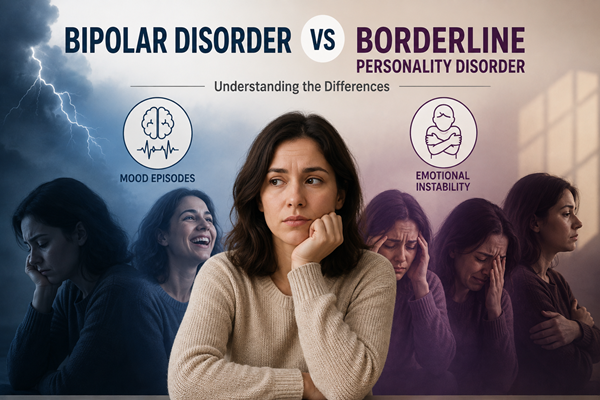
You may be searching for bipolar disorder vs borderline personality disorder, and you’re wondering why they’re so similar. Both can trigger intense emotions, impulsiveness, relationship issues and significant mood swings. However, they are not the same conditions, but have different patterns, causes and ways of looking after them. Being familiar with those differences may be beneficial to you or a family member when determining a professional’s ability to help.
Key Takeaways
- Bipolar disorder is a mood disorder characterised mainly by episodes of depression and mania or hypomania.
- The symptoms of BPD are related to enduring problems in emotional control, self-picture, interpersonal functioning, and impulsivity.
- Mood swings typically occur in a particular pattern and may last for days or weeks.
- BPD mood swings may happen very rapidly – sometimes within hours – and are frequently accompanied by interpersonal stress or a sense of rejection.
- There is a possibility for someone diagnosed with BPD to also have bipolar disorder. Each diagnosis is not mutually exclusive with the other.
- A qualified mental health professional can make a determination if symptoms are due to bipolar disorder, BPD or other conditions or if more than one condition is involved.
What is Bipolar Disorder?
The bipolar disorder is a mood disorder with predominant depressive and manic or hypomanic episodes.
Borderline personality disorder (BPD) is a disorder in which there are recurrent problems with emotional regulation, self-image, interpersonal relations, and impulsivity.
Bipolar disorder mood shifts tend to occur in a particular pattern and can occur for days or weeks.
BPD mood changes are often sudden and can happen in a few hours and are often related to interpersonal stress or rejection.
Someone may suffer from both BPD and bipolar disorder. All diagnoses are not mutually exclusive.
A qualified mental health professional can make a determination if symptoms are due to bipolar disorder, BPD or other conditions or if more than one condition is involved.
What is Borderline Personality Disorder?
Borderline personality disorder (BPD) is a mental health condition that can make it challenging to control emotions, regulate sense of self, deal with impulses and maintain relationships. Individuals with BPD can have strong feelings that can come and go rapidly and become overwhelming.
Symptoms include:
- Very sensitive to rejection or abandonment.
- If there are violent and volatile relationships.
- Rapid fluctuations of emotion.
- Lack of stability or change of identity,
- Persistent emptiness emotions
- Intense anger
- Impulsiveness or risk-taking.
- Self-destructive behavior, or suicidal thinking.
- Isolation, disembodied sensation or out of place, or alienation from others or self.
Emotional shifts can occur in BPD in hours or days. These changes can be related to an argument, rejection, fear of abandonment or some other emotionally meaningful event.
One of the two key distinctions between bipolar disorder and borderline personality disorder is that BPD is associated with emotion, relationships, self-image and reaction to interpersonal situations.
Bipolar Disorder vs. Borderline Personality Disorder: Key Differences
The best way to grasp the difference between bipolar disorder and borderline personality disorder is to examine the overall picture, rather than any individual symptom.
| Feature | Bipolar Disorder | Borderline Personality Disorder |
| Main concern | Mood episodes | Emotional regulation, relationships, self-image, and behavior |
| Mood changes | Often occur in distinct episodes | Often shift quickly and reactively |
| Mania/hypomania | Central diagnostic feature | Not a defining feature |
| Relationship instability | May occur, especially during episodes | Often a central and persistent concern |
| Sense of self | Can change during mood episodes | Often persistently unstable |
| Triggers | Episodes may occur without an immediate trigger | Emotional changes often follow interpersonal stress |
| Impulsivity | Often increases during mania or hypomania | Can occur during intense emotional states |
| Treatment focus | Often medication plus psychotherapy | Primarily psychotherapy, with medication sometimes used for specific symptoms or co-occurring conditions |
The primary difference is that there is a manic or hypomanic component. High levels of mood states are significant features of BD. People with BPD frequently experience very high levels of emotion during an episode, but such emotions are not typical of those experienced during an episode of mania or hypomania.
In the interim, signs and symptoms can overlap. Impulsivity, depression, anger, anxiety and mood instability are examples of symptoms in both conditions. It’s important to get a professional evaluation for this reason.
How Mood Changes Differ Between Bipolar Disorder and BPD
There are so many reasons to look for bipolar disorder vs. borderline personality disorder, and one of the main reasons is because of their emotional instability.
During bipolar disorder experiences with mood changes often happen as episodes. In a manic or hypomanic state, a person may be more energetic, sleep less, be more confident, talk rapidly, think quickly or be involved in risky activities. Low energy, sadness, hopelessness and loss of interest may occur with depression.
Changes in emotions are usually more rapid and more closely linked to events in the person’s life when he or she has BPD. Suddenly there may be a change in mood due to conflict with partner, fear of rejection, feeling unvalued or experiencing perceived abandonment.
For instance, a person with BPD can feel close to a person in the morning and rejected after a challenging conversation later in the day. This is not because you’re trying to pretend they are not sincere or meant. They can be more than emotional, they can be quite intense.
The length of time and the sequence is important. NIMH is talking about mood episodes, which, for BPD, last for hours or a few days; and bipolar mood episodes last much longer.
Bipolar Disorder vs. BPD: Causes and Risk Factors
No single cause of either condition.
There is a combination of genetic, biological and environmental factors associated with bipolar disorder. This could increase your chances of being diagnosed with bipolar disorder if a close family member has already been diagnosed with it.
BPD is also thought to occur as a result of a combination of genetic, biological, environmental and social factors. All of these experiences in childhood are not required for BPD.It is not required that all people with BPD experienced one or more of these things in childhood.
Don’t make a diagnosis solely based upon the history. Risk factors do not inevitably lead to mental health problems and may be different for each person, such that two people may have the same events happen to them but respond very differently.
How Are Bipolar Disorder and BPD Diagnosed?
There is no single blood test, brain scan or online test that is reliable for distinguishing bipolar disorder from BPD.
A mental health care provider will consider:
- Current symptoms
- Immediately after symptoms have been observed
- The length of time that mood changes persist
- How things unfold before and during changes of mood.
- Sleep/wake and energy cycles.
- Impulsive behavior
- Relationship patterns
- History of the personal and family life.
- Any previous medical diagnoses and medications.Existing health conditions and treatments.
- Other health problems, including drug and alcohol abuse.
With bipolar disorder, it is important to note previous manic or hypomanic episodes in particular. In BPD, a professional is looking for a pattern of emotional regulation, identity, relationships and impulsivity that is persistent over time. The NIMH says the doctor will need to spend time talking to the patient about the symptoms and behaviors of BPD, as well as their personal and family history, and explore other causes.
Occasionally symptoms are similar, making misdiagnosis possible. However, there is the possibility of having both conditions as well. A careful evaluation can help to get a more clear picture.
Looking for Professional Support?
If mood swings, impulsiveness, depression, or trouble functioning or relating to others are interfering with everyday functioning, you don’t have to make the diagnosis yourself. WellMind Therapy Center is here to help you make the next step towards a customized mental health assessment and follow-up care.
Please give WellMind Therapy Center a call today and discuss your concerns and the mental health care services that are available.
Bipolar Disorder vs. BPD: How Treatment Approaches Differ
Another distinction between bipolar disorder vs borderline personality disorder is the treatment that might be recommended.
Medication, psychotherapy, or both is typical treatment for bipolar disorder. Some medications, such as mood stabilizers, may be helpful in treating the mood episodes and psychotherapy techniques can help build coping mechanisms, routines and awareness of early warning signs and help improve relationships.
Therapy is a crucial part of BPD treatment. Skills training, like dialectical behavior therapy (DBT), can help people learn how to deal with overwhelming emotions, lessen negative behaviors, enhance relationships and handle challenging situations better.
Medications are not a primary treatment for the underlying symptoms of BPD, but can be used for some of the symptoms or for any other coexisting conditions as directed by a professional. In the new practice guideline for BPD, the APA puts greater emphasis on comprehensive and person-centered care.
Treatment needs to be tailored to the individual. The solution that works for one may not work for another.

When Should You Seek Professional Help?
Even if you aren’t sure what’s causing you emotional changes, professional help is available when it begins to become difficult to handle the changes.
Think about contacting if you see:
- Mood changes which interfere with functioning in the setting of work, school, or relationship.
- Abnormally intense or weak sleep and increased or decreased energy levels
- Sadness or hopelessness that last for more than a few days.
- Uncontrolled or impulsive behaviour.
- The feeling of being rejected or deserted.
- Frequent relationship conflicts
- The risk of suicide or self-harm thoughts are discussed
- Not having an understanding of the strong emotional responses that arise
It’s not necessary to wait for the symptoms to be severe. Early support can better help to understand patterns, contributing factors, and develop coping strategies that can be implemented.
Remember that both bipolar disorder vs borderline personality disorder are not a person’s personality disorder. These are genuine mental health disorders and individuals can make positive strides if they are supported.
When you still don’t know which condition you might have, the most secure way to understand what might be occurring is to get an expert evaluation. Please don’t self-diagnosis based on one symptom or social media checklist.
Want to take your business to the next level? If you are interested in making an appointment to discuss mental health topics with a qualified professional, contact WellMind Therapy Center. Clarifying may be the first step to becoming more stable and supported.
Frequently Asked Questions
Can bipolar disorder and BPD look similar?
Yes. Both can include mood swings, impulsiveness, anger, sadness, and problems with relationships. The main differences are in the course of symptoms and symptom severity, the inclusion of manic and/or hypomanic features, and the long-term importance of relationships and self-image.
Do people with BPD experience mood swings?
Yes. BPD sufferers may suffer from extreme mood swings, which can last hours or days. These emotional shifts can occur after rejection, conflict, fear of abandonment or other stressful interpersonal encounters.
What triggers emotional changes in borderline personality disorder?
Stressful events, such as feeling rejected, abandoned, in conflict with a partner, criticized, lonely or in conflict with others, can cause emotional changes in BPD. But triggers are different and some emotional changes can occur without any apparent triggers.
Are relationship problems more common with BPD than bipolar disorder?
Relationships may be problematic with both disorders but in BPD, unstable and intense relationships are a core feature. Bipolar disorder may also have an impact on relationships, especially in the manic, hypomanic, and depressive phases.
Can stress trigger symptoms of bipolar disorder?
Yes. Stress can trigger or aggravate bipolar symptoms and can impact sleep and activities. But bipolar mood swings are not just a response to stressful events and may happen without a clear cause.
How does impulsive behavior differ between bipolar disorder and BPD?
During manic or hypomanic phases, impulsivity may be heightened and, along with increased energy, less sleep. Impulsivity in BPD can happen when having a strong feeling, and can be correlated with interpersonal triggers. .
Disclaimer
This article is for information only and should not be used to make any diagnoses, medical advice or individual care. Bipolar disorder symptoms may overlap with symptoms of other disorders, including borderline personality disorder, depression, anxiety disorders or trauma-related disorders. Before you make a diagnosis or treatment plan, the symptoms should be assessed by a qualified mental health worker. If you have a pressing mental health crisis, or are having thoughts of self-harm or suicide, get emergency help in your area right now.
References
- National Institute of Mental Health (NIMH), Bipolar Disorder. NIMH: Bipolar Disorder
- National Institute of Mental Health (NIMH), Borderline Personality Disorder. NIMH: Borderline Personality Disorder
- American Psychiatric Association, Borderline Personality Disorder Practice Guideline. American Psychiatric Association: Borderline Personality Disorder Guideline
- NHS, Borderline Personality Disorder: Causes and Symptoms. NHS: Borderline Personality Disorder