Dialectical Behavior Therapy for Borderline Personality Disorder: Skills, Benefits, and What to Expect
It can be challenging to live with borderline personality disorder (BPD). Strong emotions, fear of abandonment, impulsiveness, relationship issues and rapid mood swings can make life harder. Dialectical behavior therapy (DBT) is an effective form of psychotherapy that teaches patients to manage their emotions, work on their relationship skills, reduce destructive behaviors, and help them learn concrete coping mechanisms to use, and to help treat borderline personality disorder (BPD).
There is no need to “control” emotions for DBT. Rather, it inculcates the ability to grasp emotions, cope with distress, express clearly and make considered choices at challenging times. With regular support and practice, a lot of people with BPD can improve their functioning and functioning in the process of reducing BPD symptoms.
Key Takeaways
- DBT is a therapeutic approach created to specifically treat a lot of BPD struggles.
- DBT is a tool that embraces the positive and acceptance. The goal is to accept a circumstance and try out various other healthier answers.
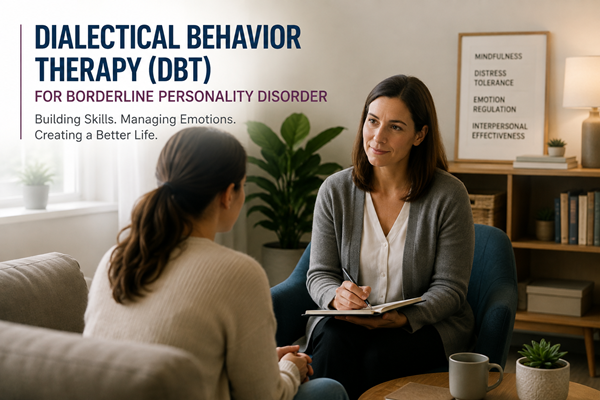
- The four pillars of DBT are mindfulness, distress tolerance, emotion regulation and interpersonal effectiveness.
- DBT could lead to a decrease in self-harm, suicidal behavior, emotional instability, impulsivity, and relationship problems.
- A full program would include individual therapy sessions and group therapy skills training for a typical program.
- DBT is not the solution to all problems. Regular attendance and practice during sessions is needed for normal progress.
- BPD can be treated and individuals who are diagnosed with BPD do not have to suffer forever.
What is Dialectical Behavior Therapy (DBT)?
Structured psychotherapy developed by psychologist Marsha Linehan and her colleagues is called DBT. It was first designed for those who suffer suicidal behavior and those symptoms related to BPD.
“Dialectical” refers to the two conflicting concepts that have to be negotiated: acceptance and change.
For instance, a therapist might explain to the person, “This is the way I feel because I am feeling this way, and how? I can do something different so that this situation is not as painful for me.”
One of the keys in dialectical behaviour therapy for BPD is this balance. Rather than “chastising” someone for being very emotional, DBT teaches them about their emotions, and teaches them how to respond to them.
The National Institute of Mental Health (NIMH) lists DBT as one of the psychotherapies that can be utilized for BPD, and reports that it can be used to teach mindfulness, emotion regulation, distress tolerance, and relationship skills.
How Does DBT Help With Borderline Personality Disorder?
With BPD feelings can come quickly and be very strong. When there is conflict with another person, when they feel rejected or isolated, or when they think they will be abandoned they may become angry, sad, and/or anxious, or overreact.
DBT for BPD can set up a buffer between an emotional activation and a person’s response.
A person can: instead of reacting in a way that is influenced by a strong emotion, they can:
- Recognize their emotions.
- Determine the cause of the emotion.
- Pause before acting.
- Use a coping skill.
- Become more articulate in expressing needs.
- Select an activity which aligns with their aims.
Self harm and suicidal ideation are also amenable to treatment with DBT. The studies indicate that the use of DBT can reduce the number of suicide attempts among adults with BPD, NIMH reports.
DBT isn’t about taking the emotion out. All of us experience sadness, anger, fear and disappointment. The intention is to make those feelings more manageable without the use of it taking over actions.
Key DBT Skills for Borderline Personality Disorder
The one great thing about DBT is that it focuses on skills that can translate to BPD. These skills may be practiced in and out of therapy.
Mindfulness
Mindfulness is how to pay attention, without judgment, to what is happening in the here and now. It is possible to listen to thoughts, sensations and feelings and become attuned but not react.
Distress Tolerance
Distress tolerance skills are employed to assist a person experiencing emotional distress to manage the distressing situation without exacerbating emotional distress. These skills are especially useful when having an uncontrollable emotional response.
Emotion Regulation
Emotion regulation is the capacity to perceive emotions, to reduce emotional sensitivity and to respond to emotions in more healthy ways.
Interpersonal Effectiveness
These skills are employed to communicate needs, set boundaries, and for the management of conflict and healthy relationships with oneself and others.
What are the Four Core Components of DBT?
The four main steps of DBT for BPD are:
Mindfulness: Practicing staying in the moment and noticing thoughts/feelings.
Distress tolerance: To learn how to tolerate distress without engaging in negative or destructive behaviors.
3. Emotion regulation: To comprehend and manage strong emotional reactions.
Interpersonal effectiveness: Communicate clearly, work cooperatively with others, set boundaries and manage conflict.
These skills are mutually dependent. For example, through mindfulness, one might be more attuned to the feeling of getting angry. They can learn to deal with the anger through emotion regulation. Distress tolerance may help them not to act impulsively, and interpersonal effectiveness may help them talk about the problem.
Benefits of Dialectical Behavior Therapy for BPD
DBT is a valuable psychotherapy treatment for BPD supported by research and clinical guidelines. The American Psychiatric Association (APA)’s current guidelines include evidence-based psychotherapies for comprehensive treatment for BPD.
People with BPD may find the following to be potential benefits of dialectical behavior therapy (DBT):
- Better emotional regulation
- Fewer impulsive behaviors
- Reduced self-harm
- Reduced suicidal behavior
- Improved distress tolerance
- Better communication
- Healthier relationships
- Improved understanding of emotional triggers.Improved understanding of emotional triggers.
- Improved ability to handle conflict
- Better day-to-day functioning
Each result is individual, and may vary from one person to another. DBT could be particularly useful if a person is trying to incorporate what they learned in a session.
What Brain Differences Occur in Borderline Personality Disorder?
What is the Brain Change in BPD? Research suggests that there are brain structural and functional differences, in regions associated with emotional regulation and impulse control, that are related to BPD. However, these differences cannot be said to be the only ones that result in BPD.
There is a complexity to the brain and a multi-factorial process in the emergence of BPD. Do not identify a person by any brain finding or make assumptions about the person’s personality being irreparably damaged.
How Effective Is DBT for Borderline Personality Disorder?
Research evidence for DBT therapy for BPD is reasonably robust, particularly in its ability to reduce suicidal ideation, emotional dysregulation and self-harm.
According to NIMH, DBT has been proven to decrease the number of adults with BPD who attempt suicide. The group also acknowledge DBT as an evidence-based psychotherapy for the disorder.
In addition, the American Psychiatric Association’s revised BPD practice guideline classifies DBT as a structured, multicomponent method that can be used to teach individuals skills in distress tolerance, emotional regulation, mindfulness and interpersonal effectiveness.
There will be varying degrees of effectiveness among people relative to another person’s. Treatment should be individualised based on symptoms, safety, other mental health issues, goals and personal factors.
What to Expect During DBT for BPD
Therapist consultation, between session skills practice, group skills training and individual psychotherapy are all can be included within a comprehensive program of DBT. There may be variations in specific programs.
During one-on-one therapy sessions, you can discuss your life situations, situations that trigger your thoughts, actions, relationships, and your progress toward treatment goals.
Typical group sessions consist of learning and practicing DBT skills.
Homework is also quite prevalent. This may be a skills worksheet, a novel communication strategy, a mindfulness or monitoring emotion strategy.
A therapist can help to create a safety plan if there is a risk of self-harm or suicide.
The most effective use of DBT for BPD is when the patient and therapist work together, engage in respectful relationships, are honest, and have mutually agreed objectives.
A Practical Example
Suppose that a person sends a message to a friend and doesn’t get a response for a few hours.
Their first thought is “They hate me,” they feel abandoned, get angry and send out multiple emotional messages.
DBT calls for a pause.
This person may become aware of the thought, recognize the emotion, employ a distress tolerance skill, think about other explanations, and delay reacting.
It’s not about lying to the person about the injury. The intention is to reply in a manner that safeguards the relationship and the person’s health.

Ready to Take the Next Step?
If these feelings are starting to get the better of you, your behaviour is becoming out of control, you are at risk of hurting yourself or there are problems in your relationships that are affecting your life, then professional help might be necessary. WellMind Therapy Center (and others) can help you find out if DBT therapy is an appropriate therapy for you or if another evidence-based therapy is better for you.
Contact and talk about your concern, ask questions about services available and take the first step in developing a set of practical skills to deal with challenging feelings.
How Long Does DBT for Borderline Personality Disorder Take?
Not all timelines are universal. When treating BPD, the treatment can last for months.
Comprehensive DBT typically takes 6 months to 12 months – and the traditional DBT programs involve individual therapy and skills training in groups weekly.
The specific course of events can take longer or shorter if the person’s needs, treatment objectives, safety considerations, progress and the DBT program type are different.
Consistency matters. What you know how to do, you may not know how to do when you are stressed. The healthier responses become more accessible as they are rehearsed more.
Who Can Benefit From DBT for BPD?
DBT-BPD may be helpful for people who have strong feelings, impulsive actions, poor relationships, attempt to harm themselves or have suicidal thoughts, and try to manage when they are feeling upset.
If users have other concerns, they can also customize their DBTs. NIMH indicates that DBT might be used with BPD and co-occurring disorders; however, this approach would need to be determined by a qualified professional.
An in-depth examination may be conducted to determine the best course of treatment: full DBT, modified DBT or other psychotherapy.
Also, it is critical to keep in mind that BPD is not a person’s identity. Symptoms can diminish, relationships can strengthen, and individuals can learn new methods of coping with emotional distress.
When to Seek Professional Help for Borderline Personality Disorder
If there is an ongoing dysfunction in daily living related to emotional reactions, impulsiveness, relationship problems, self-destructiveness, suicidal thoughts or a persistent sadness, please seek professional mental health support.
Symptoms can be assessed by a mental health professional and BPD can be distinguished from other disorders with similar symptoms, including depression, bipolar disorder, anxiety disorders, post traumatic stress disorder (PTSD), ADHD and substance use disorders.
An online checklist should not be used to make a diagnosis, it should be made by a qualified professional through a formal psychological evaluation.
If someone is in immediate danger or experiencing a mental health crisis, please reach out to the appropriate mental health crisis line in your community, utilize after-hours care options, or contact emergency services.
Frequently Asked Questions
Is DBT good for borderline?
Yes. DBT is one of the best-studied psychotherapies for borderline personality disorder. It can help with emotional regulation, self-harm, suicidal behavior, distress tolerance, impulsivity, and relationship difficulties. A qualified professional can determine whether DBT fits your needs.
Which are the 7 crucial DBT strategies?
Seven commonly taught DBT strategies include STOP, TIP, ACCEPTS, IMPROVE, DEAR MAN, GIVE, and FAST. These skills address crisis coping, distress tolerance, communication, relationships, and self-respect. Specific programs may teach and organize these skills differently.
What are the DSM-5 criteria for borderline personality disorder?
DSM-5-TR describes BPD through a pervasive pattern involving instability in relationships, self-image, emotions, impulsivity, and other symptoms. Diagnosis requires five or more specified features and professional assessment rather than self-diagnosis.
What are the “3 C’s” of BPD?
The “3 C’s” are not an official DSM-5 or DSM-5-TR diagnostic framework. They are sometimes used informally to describe experiences such as feeling controlled, criticized, or blamed. Professional assessment should rely on established diagnostic criteria.
Is BPD linked to high IQ?
There is no reliable evidence that borderline personality disorder means someone has a high or low IQ. Intelligence and BPD are separate concepts. A person’s emotional difficulties do not determine their intellectual ability or potential.
Final Thoughts
Dialectical behavior therapy for borderline personality disorder offers something practical: skills that can be used in real situations. Instead of simply discussing difficult emotions, DBT teaches people how to notice those emotions, tolerate distress, communicate effectively, and make choices that support their long-term goals.
BPD can be challenging, but it is treatable. If you are struggling with emotional instability, impulsive behavior, self-harm, or relationship difficulties, reaching out to a qualified mental health professional is an important step.
At WellMind Therapy Center, professional support can help you understand your symptoms and explore appropriate options for care. You do not have to figure everything out alone.
Disclaimer
This article is for educational and informational purposes only and is not a substitute for professional mental health evaluation, diagnosis, or individualized care. DBT may not be appropriate for everyone. Treatment decisions should be made with a qualified mental health professional who understands your individual history, symptoms, safety needs, and goals. If you are experiencing an immediate risk of harm to yourself or someone else, seek emergency help immediately.
References and Trusted Sources
- National Institute of Mental Health (NIMH), Borderline Personality Disorder — information on symptoms, causes, diagnosis, psychotherapy, DBT, and treatment.
- American Psychiatric Association, Treatment of Patients with Borderline Personality Disorder (2025 Practice Guideline) — current clinical guidance for assessment and treatment.
- National Institute of Mental Health, Frequently Asked Questions About Suicide — evidence-based information about DBT and suicidal behavior.
- National Institute of Mental Health, Borderline Personality Disorder Research and Resources — current information on BPD research and treatment.