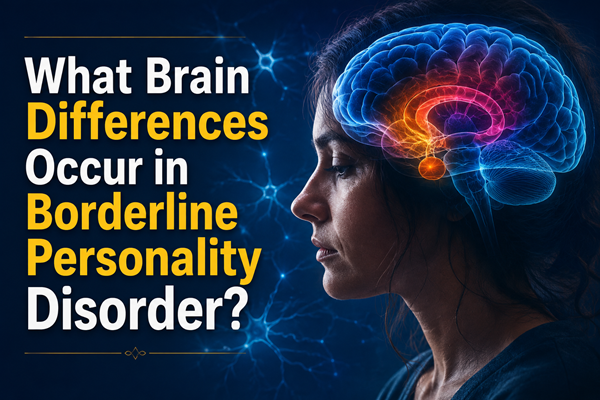
What Brain Differences Occur in Borderline Personality Disorder?
If you have ever wondered what is different in the brain of someone with a Borderline Personality Disorder (BPD), then the short answer is that there are differences in some brain areas and networks that process emotion, regulate impulse, are associated with self-awareness, and react to stressful situations. The outcomes don’t necessarily imply permanent brain damage. Rather, they think that BPD could be related to the way some of the systems in the brain are functioning and responding, particularly when it comes to emotional times.
Borderline personality disorder (BPD) is a psychological condition that may impact feelings and relationships, self-image, and conduct. Individuals with BPD can feel their feelings strongly and may lack the skill to regulate emotions. Scientists are now gaining insight into why these experiences can be so powerful as a result of brain imaging research.
Key Takeaways
- BPD has been linked to changes in the brains’ emotional regulation and impulse control areas.
- Certain people with BPD might be more responsive to emotional or threatening information in the amygdala.
- Differences in the activity and/or structure of the prefrontal cortex and related areas are possible, which would impact functioning related to emotional control and decision-making.
- The connectivity in the brain could vary across the networks of emotions, attention, self-awareness, and behavior control.
- The results are the average of medical research studies and do not diagnose BPD in any one person.
- Brain differences are not necessarily permanent brain damage due to BPD.
Successful psychotherapy has been discovered to result in changes in brain function, and Dialectical Behavior Therapy (DBT) is one of these therapies.
What is Borderline Personality Disorder?
BPD is a psychiatric disorder characterized by persistent difficulties in managing emotions, relating to others, self-image, and impulses. Extreme mood swings, fear of abandonment, relationship instability, anger, impulsiveness, emptiness, dissociation, and self-destructive tendencies are all symptoms.
BPD is complex. It’s not one cause and there isn’t a “BPD brain.” Biological factors such as genetics, early experiences, stress, relationships, temperament, and other factors all may contribute.
It’s useful to examine patterns of results across many research studies, but not just one brain scan, to gain insight into the differences in the brain that might be linked with borderline personality disorder.
The amygdala, hippocampus, anterior cingulate cortex and prefrontal regions are among the typical areas of the brain that form images of interest. Larger brain networks of interaction are also the focus of more recent studies.
What Brain Differences Occur in Borderline Personality Disorder?
Studies indicate that the differences in the brain in BPD fall into three general categories: differences in brain structure, differences in brain activity, and differences in communication between regions of the brain.
Structural studies have identified changes in the volume of gray matter and/or the thickness of the cortex in different areas of the brain, including areas of the prefrontal cortex and the limbic system. Variations in emotional tasks also have been seen in functional studies.
The most popular one is the connection with the “emotion-generating areas” and the “emotional control areas”.
Imagine this as a sort of emotional warning bell and brake. This may cause the alarm to react rapidly and the brain systems that slow down a reaction to react slowly. A simple explanation but it helps provide an understanding of one important BPD research model.
Importantly, these findings do not constitute enough for an MRI scan to make the diagnosis of BPD. Brain imaging is done as a research study, not as part of the diagnosis of BPD.
How Does BPD Affect the Amygdala and Emotional Processing?
A small part of the brain called the amygdala is involved in the detection of emotionally significant information. It is related to fear, threat evaluation, learning and emotional reactions.
The amygdala is well studied in BPD and BPD patients be responsive to emotionally salient situations. During certain functional magnetic resonance imaging (fMRI) studies of patients with BPD, increased activity in the amygdala in response to threatening and/or emotional images has been observed.
This could be part of the reason that a facial expression, disagreement, rejection or feel of abandonment can be extremely strong.
Of course, the amygdala isn’t on its own, but. There are multiple interrelated brain regions associated with emotional experiences. BPD has been recently described as a disorder of multiple networks of large-scale brain regions rather than a single region.
There have also been some structural studies reporting variations in amygdala size. It is not necessarily predictable, and this is one reason why this is an area of continuous research.
So it is more appropriate to ask “How is emotional processing and regulation different in borderline personality disorder?” than “How is the brain different in borderline personality disorder?”
What Changes Occur in the Prefrontal Cortex?
The frontal portion of the brain is called the prefrontal cortex. Helps to plan, make decisions, control attention and impulse, and manage emotions.
There have been several reported studies that found that there is a difference in the structure or activity of the prefrontal cortex associated with BPD. Another region that has been explored is the anterior cingulate cortex (ACC), a region that monitors conflict, regulates emotions and affects behavioral adaptations.
Perhaps it’s because the activation of emotional triggers can be quite intense before “regulators” of the brain catch up.
For example, if someone feels rejected, he or she may become angry, panicked or despairing right away. Over the course of time, as they are discouraged, they will think differently. Notice, it’s not that it is a person who is overreacting. It may be an indication of a strong and out-of-control emotional response.
There have been reports of differences between BPD patients and healthy controls across some prefrontal regions, both in terms of their levels of impulsivity and in their overall severity of BPD.
This is why it is not just a matter of one area of the brain being “underactive” in BPD. The results may vary across regions based on the emotion and/or task analyzed.
How Does BPD Affect Brain Connectivity?
Brain connectivity is the interaction and activity of different areas of the brain.
Recently, resting state fMRI has identified dysfunction of inter- and intra-network connections between emotion, attention, self-related thinking and cognitive control networks. These networks are the default mode network, salience network and central executive network.
The salience network assists the brain to determine what to pay attention to. The default mode network is correlated with thinking about oneself and introspecting. The central executive network is involved in cognitive control and planning, attention.
These systems are not necessarily as malleable, and emotional information is more difficult to manage in the process of communication. When sad, it can be hard to think of alternatives, to think about rejection, to shift the focus.
A 2024 study revealed that dysfunction of the frontolimbic and default-mode networks might be associated with emotion regulation and self-referential processes in BPD.
How Do Brain Differences Influence BPD Symptoms?
The above brain results could be used to shed light on some of the typical symptoms of BPD.
Rapid switching between emotion and control processing systems, or high emotions and communication between the two can lead to increased emotional reactivity and rapid switching or overwhelming emotions.
Impulsivity: Differences in the prefrontal system to control behavior can lead to impulsivity problems, which can make it harder to prevent oneself from acting when emotional.
Avoidance of abandonment: Brain systems of threat sensitivity, attachment and social information can be sensitive to experiences that are perceived as rejection or separation.
Relationship problems: Neutral events can escalate to threatening or personal relationships because of emotions.
Dissociation: They may experience time periods when they are feeling disconnected or detached from themselves and/or their surroundings. However, these experiences may be due to several interacting systems in the brain and the mechanisms are under investigation.
Those links are helpful to the understanding of the symptoms, but not to be used as a “cover” for the other person to use when answering, “It’s just brain chemistry.” BPD impacts the person’s thought processes, emotions, relationships, behaviour and life experiences.
A Helpful Way to Think About the BPD Brain
Think about an emotional situation, such as a car.
The amygdala may be an alarm system that alerts the person to an event of great importance that is happening at a rapid pace. The prefrontal areas are involved with making decisions as to what to do next and also evaluating the situation. Other brain networks play an important role in attention, memory, self-awareness, and social interpretation.
In BPD, these systems might not function as well together in emotional circumstances.
These patterns are changeable; the key is that they are important.
There are professional resources available if you or a loved one is having extreme emotions, exhibiting behavior problems, experiencing relationship difficulties, or suffering from symptoms of BPD.
WellMind Therapy Center will be able to tailor mental wellness help to comprehend signs, develop emotional control abilities, and help enhance day-to-day functioning. Please give us a call and we will determine for you what the best solution is.
Are Brain Differences in BPD Permanent?
At present, there is no evidence that BPD has long-term impacts on the brain.
Some brain imaging research has been conducted in groups of people with BPD and in comparison groups and there are some differences. These findings should not be regarded as a ‘distinct pattern of the brain’ for everyone with a diagnosis of BPD, nor should they be interpreted as implying that BPD permanently alters the brain.
Trauma exposures, medication use, other mental health issues, age, substance use, and study techniques are other research challenges.
The investigators noted that while more detailed, the neuroimaging data in BPD is still an evolving field in a review of 2024.
This is a crucial difference as it relates to brain differences in BPD. While changes in an MRI may not be a certain indicator of brain injury, it is certainly worth considering.
Can the Brain Change With BPD Treatment?
Yes. Brain development is an ongoing process and recent studies indicate that brain activity and connectivity changes can be altered in BPD individuals through psychotherapy.
Dialectical Behavior Therapy (DBT) is one of the most popular evidence-based psychotherapies that is applied to BPD. Understand how to use DBT to settings for intense emotions, tolerating distress, improving relationships and minimizing impulsive responses.
Past studies have found alterations in amygdala activity after DBT, such as decreased amygdala activation and better emotional regulation.
Recent studies have shown that psychotherapy can induce changes in neural activity, including changes in activity in emotional processing and cognitive control.
A more recent review of the neuroimaging literature adds that there is growing evidence for psychological and biological treatments affecting regions of the brain involved in emotional processing and behavioral control, but more large-scale studies are needed for this.
Unfortunately, this is not easy or even certain to “rewire the brain.” Repeated experiences of healthier emotional + behavioral responses, however, may be related to changes in brain system functioning.
It’s a great time to seek assistance! While symptoms may resolve, with effective treatment, people can lead a stable and satisfying life with BPD.
How is Borderline Personality Disorder Diagnosed?
The diagnosis of BPD is made using a thorough mental health assessment. At this time there is no blood test, brain scan or one single neurological test to confirm the diagnosis of BPD.
The mental health professional trained to conduct the assessment will scrutinize emotional patterns, relationships, behavior, personal history and family history as well as a person’s symptoms. The clinician also takes into account other conditions which may have overlapping symptoms.
This is important as BPD can co-occur with any or all of the following disorders: depression, anxiety disorders, bipolar disorder, PTSD, other disorders.
For instance, in BPD, mood changes occur but the type of mood change and duration of the mood change may be different as compared to BD. By thoughtful examination, the best diagnosis and help can be determined.
Brain imaging can lead to research, but should not be used as a stand-alone measure of BPD.

When Should You Seek Professional Help for BPD?
When strong emotions, impulsiveness, relationship problems, fear of abandonment, self-destructive behaviors and/or severe mood swings are interfering with how you feel like spending your time or your ability to function in your daily life, ask for professional help.
Don’t wait until symptoms are present.
You can find a mental health professional who can see what’s happening and develop a plan that’s right for you. Evidence based psychotherapy can offer some very real tools that can help you to regulate your emotions, tolerate distress, and communicate and develop a healthier relationship.
If you (or someone you know) are in danger of committing suicide or are seriously at risk, call for help or contact an appropriate crisis service.
Gaining insight into the differences in the brain of a borderline personality disorder can lessen the feelings of shame and provide an explanation for the experience of emotions being so strong. A scan of the brain is not a person, however. This treatment can help to control BPD and individuals can learn different strategies for how to manage their emotions, relationships and stress.
Frequently Asked Questions
Can BPD change the way the brain processes emotions?
Yes. Research suggests that some people with BPD show altered activity in the amygdala and related emotion-regulation networks. These differences may contribute to stronger emotional reactions and difficulty returning to a calmer state.
Does borderline personality disorder damage the brain?
No. BPD should not be described as permanent brain damage. Imaging studies identify group-level differences in structure and function, but they do not mean that the brain is injured or irreversibly damaged.
What part of the brain is affected by BPD?
BPD is associated with differences across several brain regions, including the amygdala, hippocampus, prefrontal cortex, and anterior cingulate cortex. Researchers increasingly view BPD as involving interconnected brain networks rather than one affected area.
Can therapy change brain activity in people with BPD?
Research suggests that psychotherapy, particularly DBT, can be associated with changes in brain activity related to emotion regulation. Studies have reported reduced amygdala activity and other neural changes following treatment, although research remains ongoing.
Is borderline personality disorder a neurological disorder?
No. BPD is classified as a mental health disorder, specifically a personality disorder. Although brain biology plays a role, diagnosis is based on psychological and behavioral patterns rather than evidence of a single neurological abnormality.
Final Thoughts
Research into what brain differences occur in borderline personality disorder is helping clinicians and scientists better understand emotional dysregulation, impulsivity, relationship difficulties, and other BPD symptoms.
The strongest message is that BPD should not be viewed as a damaged or hopeless brain. Current research points to differences in brain regions and networks involved in emotion and behavioral control, while treatment research suggests that these systems can show changes alongside clinical improvement.
If BPD symptoms are affecting your relationships, work, emotional well-being, or safety, professional support can make a meaningful difference. Contact WellMind Therapy Center to learn more about personalized mental health support and take the next step toward better emotional stability and quality of life.
Disclaimer
This article is intended for educational and informational purposes only. It is not a substitute for diagnosis, medical advice, psychotherapy, or individualized care from a qualified mental health professional. Brain imaging findings discussed here describe research trends and cannot be used to diagnose BPD in an individual. If you are experiencing a mental health emergency or thoughts of self-harm or suicide, seek immediate professional or emergency assistance.
References
- National Institute of Mental Health (NIMH): Borderline Personality Disorder — Information on BPD symptoms, diagnosis, co-occurring conditions, and treatment.
NIMH: Borderline Personality Disorder - Ruocco AC, Marceau EM. Update on the Neurobiology of Borderline Personality Disorder. Current Psychiatry Reports, 2024. This review summarizes structural, resting-state, and task-based brain imaging findings.
PubMed: Update on the Neurobiology of BPD - Resting-State Functional MRI Alterations in Borderline Personality Disorder: A Systematic Review. This review examines differences in connectivity across major brain networks.
PubMed: Resting-State fMRI Systematic Review - Neural Changes in Borderline Personality Disorder After Dialectical Behavior Therapy: A Review. This review evaluates evidence for neural changes following DBT.
PubMed: Neural Changes After DBT - Dialectical Behavior Therapy Alters Emotion Regulation and Amygdala Activity in Patients With BPD. This study examined changes in amygdala activity and emotion regulation following DBT.
PubMed: DBT and Amygdala Activity