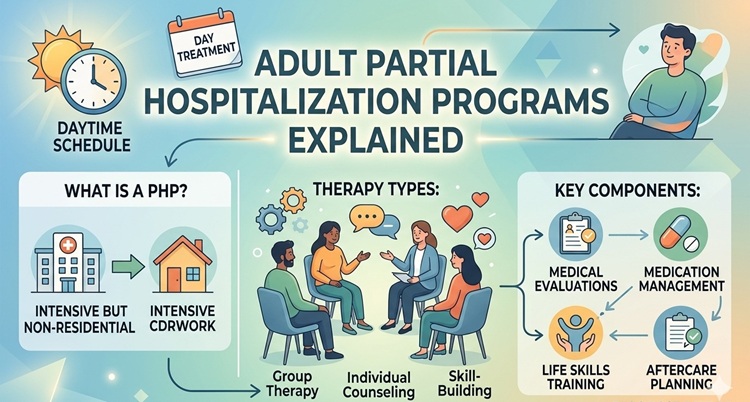
Adult Partial Hospitalization Programs Explained: What You Need to Know
Key Takeaways
- The adult treatment programs offered are partial hospitalization, which delivers psychiatric treatment during the day but is not clinically full.
- They bridge the outpatient and inpatient gap of 24-hour hospitalization.
- These programs are conducted in group sessions, with activities, skills training and medication management.
- Everyone gets to go home each night and stay in touch with family and community.
- There is evidence-based adult partial hospitalization (termed “acute programs of care”) for acute mental health crises, depression, anxiety and other serious mental illnesses.
- They provide economically viable treatment options that are clinically effective alternatives to inpatient treatment.
- These strategies focus on ways to recover, get empowered and develop coping resources for future use.
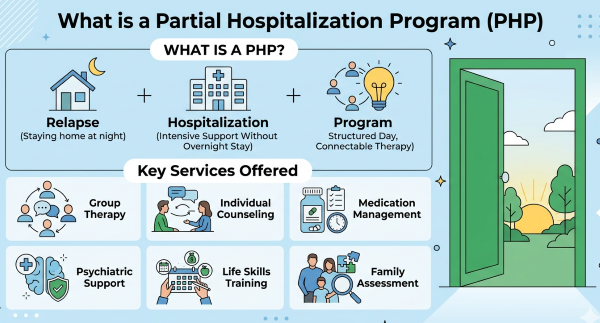
Partial hospitalization programs (PHPs) are intensive mental health care for adults who are having severe psychiatric symptoms and do not need to be in inpatient care around the clock. These are treatment-only programs that will admit people for crisis stabilization, therapy, skills training, and medication management during the day and release them home in the evening.
Adult PHPs serve as a stepped-up therapy intervention and are effective in managing a variety of mental health conditions, especially depression, anxiety and bipolar disorder, while offering patients the benefit of maintaining social and family support networks.
What Are Adult Partial Hospitalization Programs?
You may have been dealing with mental health issues, and if your therapist did prescribe a “step down” from a hospital or otherwise change your plan to not be inpatient, you may be wondering what the “step down” is. The middle has been the adult partial hospitalization program (PHP), which offers intensive care without 24-hour commitment, which a psychiatric hospital offers.
Adult partial hospitalization programs are outpatient programs for the diagnosis and active treatment of serious mental illness, according to the American Association for Partial Hospitalization.
Partial hospitalization programs for adults last several hours per day (usually between 4 and 8 hours) and are provided several days a week, different from traditional therapy sessions, which last one hour. Placed in a structured setting with other participants, clinical personnel and therapists, while at night, you will be taken back home.
This model became more popular in the middle of the 2nd World War, as there wasn’t room for all the people in the hospital, thus providing intermediate programs. They have grown a great deal since then and now they are seen as a viable alternative to inpatient psychiatric treatment for a person who is in crisis and not a danger to themselves or others at night when they could return home.
How Do Adult Partial Hospitalization Programs Work?
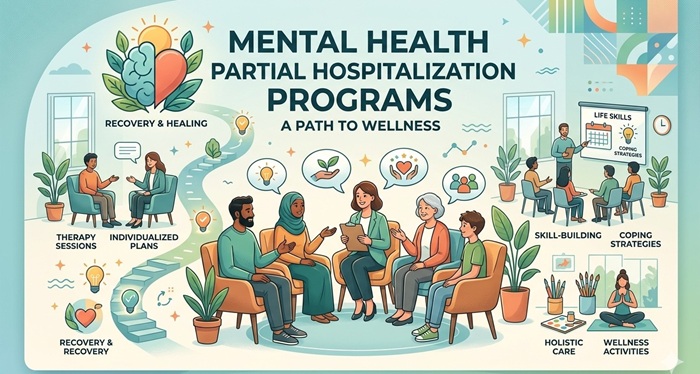
Adult partial hospitalization programs can design the types of services that they provide in different ways, but they are more connected to your clinical home during the day. You will probably be there for group therapy sessions, skills training sessions, psychotropic management sessions, and recreational activities. Your progress is evaluated and treatment is modified on a daily basis by staff.
The difference between PHP and regular therapy is the immersive nature, which leads to intensive therapy. The person on the therapy list is not the person you meet each week as a therapist; it’s a therapeutic group of peers and staff that provide feedback, support, and accountability. This is not only an intellectual understanding of coping skills, but shows research that this environment can actually help to teach coping skills at an emotional and cognitive level.
Many of the partial hospitalization centers that focus on rehabilitation in adults offer behavioral activation, occupational therapy and recreation as part of their counseling. These are all as part of their aim of restoring structure, confidence and resuming activities you’ve lost interest in. They also closely interact with psychiatrists in medication management so that if the changes are needed, they can be done when you are closely supervised.
The Difference Between PHP and Inpatient Treatment
A common misconception is that PHP treatment is similar to psychiatric hospitalization.
The key difference is that adult partial hospitalization programs do not require overnight stays.
| Feature | Partial Hospitalization Program | Inpatient Treatment |
| Overnight Stay | No | Yes |
| Level of Supervision | Structured Daytime Care | 24-Hour Care |
| Home Environment | Returns Home Daily | Lives at Facility |
| Cost | Often Lower | Usually Higher |
| Independence | Greater | More Restricted |
This flexibility allows participants to maintain family responsibilities, practice coping skills in real-life situations, and remain connected to their support systems.
Who Can Benefit from Adult Partial Hospitalization Programs?
Adult partial hospitalization programs are best for those with immediate mental health problems whose situation is acutely threatening and who are not in imminent danger of suicide or homicide (patients who are in immediate danger must be admitted to inpatient services). Common situations include:
- Major depression, not currently suicidal but with hopeless feelings or depression in general
- Anxiety or panic disorder that has not been controlled using normal treatment methods
- Mood episodes of bipolar disorder
- Personality disorders in which intensive group work has proven to be very helpful
- Moving from hospital to steps to daily living to prevent (or buffer) hospital relapses
What is important is that you are needed for intensive support, but can go home safely at night. For individuals at acute risk of suicide and severe psychosis, adult partial hospitalization programs are not appropriate levels of care as inpatient treatment would typically be required.
Why Are Adult Partial Hospitalization Programs Effective?
There are a number of reasons why adult partial hospitalization programs are effective.
First, it’s far more intensive treatment than what you’d receive in typical outpatient care. People will get several treatments per week, instead of one per week.
Secondly, participants can also utilize new coping skills “in the here and now”, in their “real world.” They learn every day in treatment and go home in the evening and practice their lessons every day.
Third, the known types of partial hospitals are 24-hour psychiatric monitoring, allowing for treatment teams to make interventions at the proper time.
Signs You May Need a Higher Level of Care
The symptoms of mental health problems are on a continuum. Whereas sometimes outpatient therapy might not be sufficient.
Signs can vary from person to person but they may include the following:
- Persistent depression
- Severe anxiety
- Frequent panic attacks
- Thoughts of suicide (but without immediate intent)
- Emotional instability
- A significant number of problems working or living in the home.
- Increased substance use
- Mental health crisis, mental health crises time and again.
Weighing in on these concerns at a young age may help people to be able to get to adult partial hospitalization centers before the symptoms progress.
Understanding the Benefits of Adult Partial Hospitalization Programs
The primary benefit of an adult partial hospitalization program is the context. You learn coping and apply it right away in real-life situations at home, among family members, and in your community. That is a pragmatic application that is so important, whereas learning at the hospital and then knowing how to adapt in the real world when you get out.
Adult partial hospitalization programs are more effective than inpatient-only therapy, as well, with respect to their ability to promote social adjustment. During the night, you’re at home, so you’re connected to your family system, which may be supportive, challenging or whatever, but it’s real. You are dealing with the reality of relationships, not later on as you wish to deal with them.
Adult partial hospitalization programs have a consistent track record of patient and family satisfaction scores being higher than inpatient services. A year after discharge, the positive long-term results are more likely to be reported, which is probably because there is more interest in actually learning recovery skills to apply for recovery in the future, rather than just stabilization.
Also, PHP offers a step-down program to shorten inpatients’ stays. Why weeks in the hospital when you could spend one week inpatient and then move to adult PHPs for several weeks? Why observe for weeks in the hospital when time to observe could be reduced and outcomes improved by spending one week inpatient and several weeks in the adult PHPs?
The Treatment Structure and What to Expect
Most adult partial hospitalization programs are located Monday through Friday (and on Saturdays for some programs). Inspectors spotted the following on your day:
- Patients will check in with their treatment team in the morning.
- One-on-one consultation or psychiatric consultation
- Supportive group therapy on skills or processing an experience
- Group or individual classes focused on areas such as anger management and emotional regulation or communication skills.
- Rec. and occupational therapy for behavioral activation.
- Storing and administering medication if required.
- A discharge plan to help prepare for transition out of the hospital.
You will be encouraged to create treatment goals you and a care coordinator will work on. These feelings of needing to ‘fix things’ are specific: “I would like deeper communication with my partner” versus “I want to be happy. This specificity results in accountability and measurable progress.
Treatment isn’t linear. You’re going to have bad days and good days, and that is normal – part of being on the path of recovery, not part of the definition of failure. There is also accountability that motivates in the context of adult partial hospitalization programs, which tend to be more time-limited (4–12 weeks). You and your health care provider know there’s a date for a time of healing, and this can sometimes lead to focused and purposeful efforts.
Are Adult Partial Hospitalization Programs Right for You?
If you are thinking of considering an adults’ partial hospitalization program, consider the following:
- Do I feel safe at home at night (I am not actively suicidal or homicidal)?
- Are my needs for assistance more than what a normal outpatient program offers, or less than a 24-hour hospital stay?
- Will you dedicate some time each week for daytime programming?
- Am I committed to working towards a specific and clear goal?
- Would I like to learn and practice coping skills in a community?
If you’ve said ‘yes’ to most of these, it is good to discuss this with your therapist or psychiatrist. They can assist in deciding if this is a level of care that’s appropriate for your needs at this time.

Ready to Take the Next Step?
Don’t go through depression, anxiety, a mental health crisis or recovery from hospitalization alone. Our Adult Partial Hospitalization Programs (PHP) provide you with a full-service, intensive therapeutic experience designed with you in mind and support real, lasting recovery.
You’ll get a customized treatment plan tailored to your needs, goals, and treatment preferences from our experienced therapists, counselors and psychiatrists.
You can call WellMind Therapy Center today to set up a consultation and discover just how AHP might help you on the course to better mental well-being.
Frequently Asked Questions
At what point do I need to admit myself to a mental hospital?
If you’re experiencing active suicidal or homicidal thoughts that feel uncontrollable, severe psychosis, or are unable to care for yourself safely, inpatient hospitalization is appropriate. A crisis line or emergency room can help assess whether hospitalization is needed, or adult partial hospitalization programs might serve as an alternative if you’re stable enough to go home at night.
How long does PHP typically last?
Most adult partial hospitalization programs run between 4 and 12 weeks, depending on your needs and progress. The time-limited structure helps create focus and motivation. Your treatment team will monitor progress and work toward transitioning you to less intensive outpatient services when you’re ready.
Are PHP programs worth it?
Research consistently shows that adult partial hospitalization programs are clinically effective and cost-effective compared to inpatient hospitalization. People report higher satisfaction with their care and better long-term outcomes. If you need intensive mental health support but are safe going home at night, the return on that investment—in terms of recovery and quality of life is significant.
What is the #1 most diagnosed mental disorder?
Anxiety disorders are the most commonly diagnosed mental health conditions, affecting millions of people. Within that category, generalized anxiety disorder and social anxiety disorder are particularly prevalent, though depression is also extremely common and often co-occurs with anxiety.
What happens after PHP treatment ends?
Discharge planning begins on day one of your adult partial hospitalization program. Before you graduate from the program, your team will connect you with ongoing outpatient providers a therapist, psychiatrist, or both to continue care. Many people transition to weekly or bi-weekly therapy to maintain the progress they’ve made.
What Is the 3 Month Rule in Mental Health?
The “3 month rule” is not an official psychiatric guideline. However, clinicians may use a three-month timeframe to evaluate symptom persistence, treatment response, and progress before adjusting treatment plans or considering alternative levels of care.
At What Point Do I Need to Admit Myself to a Mental Hospital?
Hospitalization may be necessary when symptoms create an immediate risk to personal safety or the safety of others. Suicidal thoughts, severe psychosis, inability to function, or medical instability often require emergency evaluation.
Are PHP Programs Worth It?
For many individuals, adult partial hospitalization programs provide meaningful benefits by offering intensive treatment without full hospitalization. Participants often receive more support than traditional outpatient therapy while maintaining important personal and family responsibilities.
How Long Does PHP Typically Last?
Most adult partial hospitalization programs last between two and eight weeks, depending on clinical needs, symptom severity, treatment goals, and progress. Some individuals may transition to intensive outpatient programs or standard outpatient therapy afterward.
What Is the #1 Most Diagnosed Mental Disorder?
Anxiety disorders are generally considered the most commonly diagnosed mental health conditions worldwide. These disorders affect millions of adults and can range from generalized anxiety disorder to panic disorder, social anxiety disorder, and specific phobias.
When to Walk Away from Someone with Mental Illness?
Supporting a loved one with mental illness is important, but maintaining personal safety and healthy boundaries matters as well. If a relationship becomes abusive, consistently unsafe, or harmful despite professional intervention, creating distance may be necessary.
Disclaimer
This blog post is for educational and informational purposes only and should not be considered medical advice. Adult partial hospitalization programs are not appropriate for everyone, and your individual situation requires professional evaluation. If you’re experiencing a mental health crisis, suicidal thoughts, or homicidal thoughts, please contact emergency services, call 988 (Suicide & Crisis Lifeline), or go to your nearest emergency room immediately. Always consult with a qualified mental health professional before deciding on any course of treatment.
References
- National Institutes of Health (NIH). Partial Hospitalization Programs and Their Role in Mental Health Treatment. https://pmc.ncbi.nlm.nih.gov/articles/PMC2848466/
- American Psychiatric Association (APA). Mental Health Services and Levels of Care
- National Institute of Mental Health (NIMH). Mental Health Information and Treatment Resources.