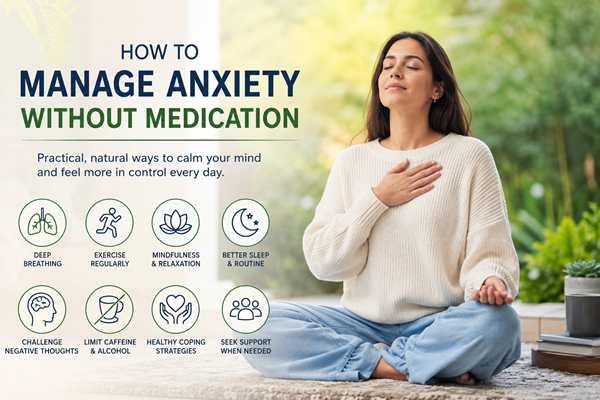
How to Manage Anxiety Without Medication
Anxiety can impact your thoughts, body, sleep, relationships and day-to-day life. There are steps you can take to manage anxiety without medications. There are several breathwork, exercise, sleep, mindfulness, healthy habit and support practices that can help to alleviate the impact of anxiety. For some individuals, it is sufficient to use these techniques to control mild anxiety; others may require professional assistance.
But remember this is not only about “thinking positively” with regard to anxiety. Anxiety disorders are persistent and can be debilitating. There are alternatives to medication – therapy and lifestyle changes – that you can make – even if you don’t take medication – and they’re a great option if medication isn’t an option.
Key Takeaways
- But one way to ease anxiety is to have good coping mechanisms and healthy habits.
- Knowing what triggers your anxiety can assist you to respond to it before it becomes overwhelming.
- The body relaxation exercises and slowing down of breathing can help promote relaxation of the body’s stress response.
- Maintaining an exercise regimen, regular sleep and routine can help with emotional well being.
- Mindfulness is important to be aware of anxious thoughts without reacting.
- If you find that some substances like caffeine and alcohol aggravate your symptoms, you may want to avoid them.
- Don’t try to deal with intense and long-lasting stress alone.
- There are lasting skills that can help you cope with your anxiety without the help of medications, and a professional can give you a helping hand.
Understand What Triggers Your Anxiety
A crucial part of learning to manage anxiety without medications is knowing what tends to trigger your anxiety.
Each person has his or her own triggers. Too much work, relationship problems, money, social life, health, lack of sleep, caffeine, big life changes or a lot of thinking about an uncertain or unknown outcome – all of these can be examples.
Try using a brief anxiety journal for 1-2 weeks. Write down:
- What had happened to you prior to your feeling anxious?What had occurred prior to your feeling anxious?
- What did you think of as you were doing this?
- How your body felt when you were there.How you felt in your body there.
- The degree of the stress experienced
- What did you do to make yourself feel better?
There are now emerging patterns. For instance, you may find that your anxiety flares up when you don’t get a good night’s sleep or have lots of coffee.
If you recognize what your triggers are, you can make tiny adjustments instead of waiting till anxiety gets to be too much.
Practice Deep Breathing and Relaxation Techniques
Your body can jump into the danger mode when anxiety increases. Your heart rate may be elevated, you may breathe rapidly and shallowly, and may have tight muscles.
Breathing slowly gives you a quick and easy method of stopping to relax.
Try this exercise:
- Sitting comfortably and relaxing shoulders.
- Slowly breathe in through your nose.
- Let stomach fill with breath.
- Exhale slowly and gently.
- Repeat as many times as necessary, for several minutes.
Remember to breathe not too quickly or too deeply. Instead, attempt to breathe slowly, comfortably and steadily.
Alternate with progressive muscle relaxation, gentle stretching or guided relaxation. These strategies can be used to help establish your overall approach to managing anxiety, but should not be used as a substitute for professional treatment of severe anxiety.
Exercise Regularly to Reduce Anxiety
Another effective non-drug way to deal with anxiety is exercise.
If someone is engaged in an activity, his or her mind is less likely to be open to worry and the body will release the tension. It doesn’t mean that you must do a very intense workout to start.
Take into account activities like these:
- Walking
- Cycling
- Swimming
- Dancing
- Yoga
- Light strength training
- Stretching
Get going with an activity that you’re truly enjoying. Any amount of walking is more likely to be adhered to than a hard-to-follow workout that isn’t fun.
The aim is to be consistent and not perfect. Regular exercise throughout the week may help to enhance mood, sleep and stress management, NIMH also names exercise as one of the healthy habits that can be helpful in alleviating symptoms of anxiety.
Improve Your Sleep and Daily Routine
With poor sleep, it can be difficult to get a good night’s rest and to avoid anxiety. You’re feeling anxious, sleeping poorly and then feeling even more emotionally overwhelmed on the following day.
Having a fixed routine may be beneficial to reduce some of the all-encompassing sense of chaos.
Try to:
- Keep a regular schedule for getting up and going to bed.
- Take the time to relax before going to sleep.
- Make bedroom comfortable and quiet.
- Limit caffeine later in the day.
- Try not to look at a screen for extended periods of time before bed.
- Obtain some natural light and exercise in the daylight hours.
It’s not necessary to make an ideal routine immediately. Make one or two changes and build off of them.
Regular sleep and healthy daily routines for mental well-being are recommended by NIMH.
Use Mindfulness to Manage Anxious Thoughts
Mindfulness isn’t a way to prevent all negative thoughts.
Instead, it’s about seeing what is happening in the ‘here and now’ without making any judgements or ‘fighting’ it.
For instance, don’t think:
“There’s something bad that’s going to happen.”
You might notice:
“A thing that I am concerned about that might happen.”
This little space is the distance from you and the thought.
Mindfulness can be done sitting, walking, eating or while doing any other day to day activity. Describe what you see, hear, feel, smell and taste.
There is emerging evidence for using mindfulness for anxiety, with inconsistent findings across the different types of mindfulness and anxiety.
Challenge Negative and Worrying Thoughts
If people are worried, what they don’t understand can be more frightening than what they do.
There may be times when you wonder:
- What if things end up going wrong?
- “Can’t take this, I can’t take this.”
- “All will be judging me.”
- “There is something bad that will surely happen.”
What if things end up going wrong?
I can’t take this, I can’t take this.
“All will be judging me.”
“Someting bad will definitely happen.”
Instead, you should consider this thought, ask yourself:
What are the indications that support this thought?
What evidence does not agree with it?
Am I taking the pessimistic view point?
If I met a friend whom I cared for and he had this concern, what would I say?
This is not to disregard genuine issues. It is a capability of making a distinction between what is real and what is fears-based predictions.
Similar skills are taught in cognitive behavioral therapy (CBT) in an attempt to teach people to recognize unhelpful thought patterns and learn more healthy ways to cope with anxiety.
Limit Caffeine, Alcohol, and Other Anxiety Triggers
Some people may find that some substances enhance the feeling of anxiety.
For instance, caffeine. Some supplements, coffee, energy drinks and tea contain caffeine. Try to limit caffeine if it increases restlessness, increased thinking or heart palpitations.
Alcohol also has a negative impact on sleep and mood. Drinking alcohol can temporarily help with anxiety, but can also lead to other problems.
Don’t get rid of all at once, listen to your body. Keeping a short food and mood record will help you to determine your food triggers.
One of the healthy stress-management practices recommended by NIMH is to limit caffeine intake.
Create Healthy Coping Strategies for Anxiety
If you have a few strategies to deal with anxiety, it would be easier to learn to, rather than one.
Develop an own “calm down plan” to follow when feeling anxious.
Your plan may consist of:
- This could be a relative, friend or neighbour.
- Shambling around a bit
- Practicing slow breathing
- Listening to relaxing music.
- Expressing emotions in writing.
- Having a hot bath or shower.Having a hot bath.
- Spending time outside
- Practicing mindfulness
- Doing something creative
- Taking a break from social media
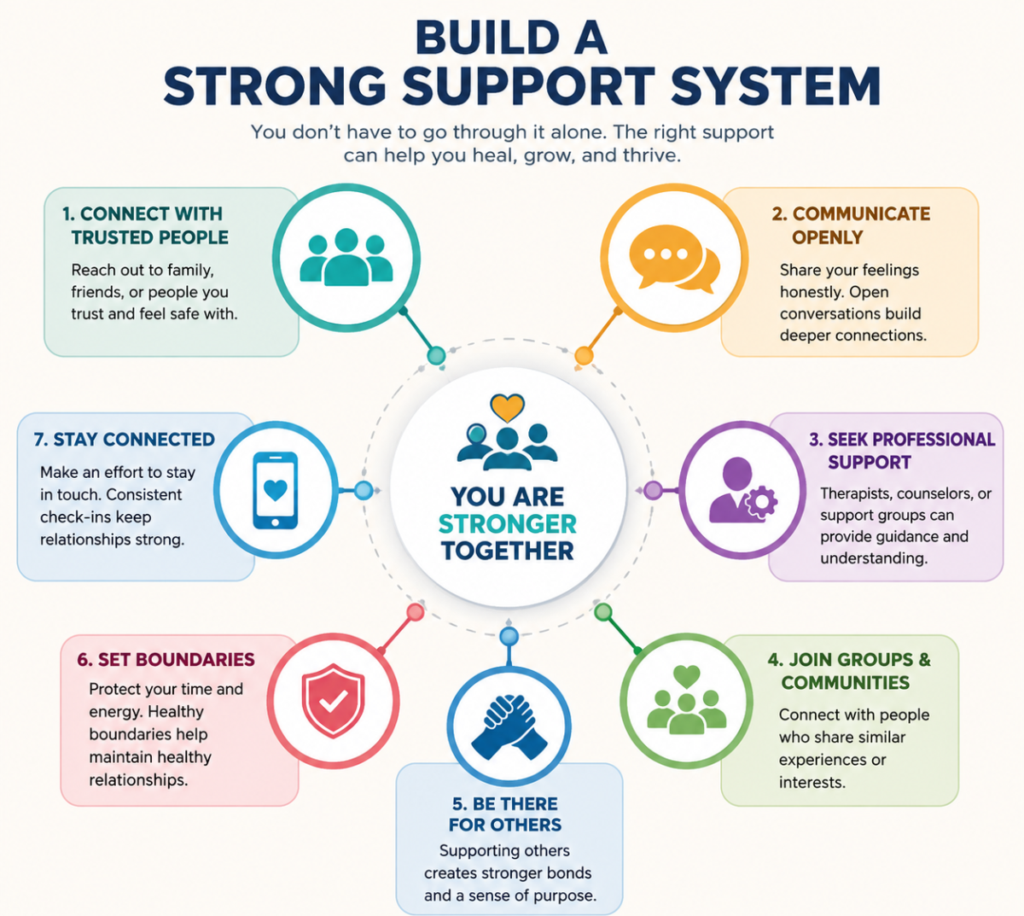
Another option is to communicate with a trusted individual about what you’re feeling. Social support can reduce the sense of loneliness with negative feelings.
The most important – Set reasonable expectations! This anxiety might not go away all at once. It’s about learning to recognize it, work through it and get past it.
Overall, WellMind Therapy Center is a great resource for anyone seeking to enhance their mental health.
However, if anxiety is interfering with your ability to work, maintain a relationship, sleep and live your life, you don’t have to do it all by yourself.
WellMind Therapy Center will assist you to pinpoint what could be triggering your anxiety, and give you some straightforward techniques that will work for you. Reach out to us today to learn about mental health resources and steps to take the next step.
When Should You Seek Professional Help for Anxiety?
Self-help techniques may be helpful, especially for occasional or mild anxiety. But if anxiety is chronic, out of control and/or impairs functioning, it needs to be addressed by a professional.
If you have symptoms, try to get professional assistance if you:
- Has a lot of stress and worry almost all of the time and finds it hard to deal with worry.
- Don’t work, go to school, do social activities and/or tasks.
- Have numerous panic attacks.
- Are having ongoing sleep problems.
- Has trouble focusing
- Is easily irritated or gets tense when in public places.
- Resort to alcohol or drugs to deal with stress
- Be aware that anxiety is impacting on relationships
- Realize strategies that were once successful are not successful now.
Help doesn’t need to be in the form of drugs. Medications are not necessary for psychotherapy; however, certain types of psychotherapy can teach skills that help you to be aware of and react to anxiety. NIMH suggests that psychotherapy might work for generalized anxiety disorder, and can be delivered face-to-face or through telehealth.
If anxiety is a more serious problem causing issues with your life, it’s okay to ask for help from a mental health professional who can assist you.
Final Thoughts
The first step in learning to manage anxiety without medication is to identify your anxiety triggers and develop practical skills that will benefit your mind and body. You can include better sleep, regular exercise, mindfulness, slow breathing, healthy habits and challenging unhelpful thoughts as part of your coping plan.
But it is not something you have to deal with by yourself. If anxiety persists even after you try to manage it, or becomes part of your daily life, you can find professional help to understand what’s going on and how to take steps to address it.
Getting help can be the first step to finding healthier ways to cope with anxiety and in regaining confidence in your everyday life, at WellMind Therapy Center. Contact us to discuss your options and make a change for the better with respect to your emotions.
Frequently Asked Questions
How to reduce anxiety naturally?
Slow breathing, regular exercise, good sleep hygiene, avoiding overconsumption of caffeine, practicing mindfulness, challenging anxious thoughts and maintaining an environment of supportive people are all ways to reduce anxiety naturally. When symptoms do not resolve, professional assistance can offer other coping techniques.
What is the 3-3-3 rule of anxiety?
3-3-3 is a grounding technique. Find 3 things you can see, 3 things you can hear and move or identify 3 parts of your body. It can help to focus attention on the here and now.
What are some effective herbal remedies for anxiety?
There is limited and mixed evidence for chamomile and lavender as anti-anxiety herbs. Herbal products can also have interactions with medications and/or side effects. Discuss supplements with a health care provider before using, particularly on a regular basis or in large quantities.
Can I fix anxiety without medication?
Mild anxiety can be successfully treated with a combination of lifestyle changes, coping skills and psychotherapy without the use of medication for some people. However, anxiety disorders can be serious. Your doctor or other health care professional will be able to tell you if non-medication options are suitable for you.
What drink calms down anxiety?
Some drinks might work for others to soothe anxiety, but not all. Drinking water or caffeinated drinks might be appropriate. Chamomile tea can be used for relaxation, but there is limited and inconclusive evidence for its use in anxiety.
How much anxiety is normal?
Normal anxiety responses to stress, uncertainty or significant events. When worry persists, is hard to control, leads to distress and/or disrupts work, relationships, sleep, or daily functioning, it becomes more concerning.
Disclaimer
This article is for general educational and informational purposes only. It is not intended to diagnose, nor is it a substitute for personalized information from a trained mental health or health care provider. Anxiety may come in a variety of forms and intensities. Never skip, decrease or discontinue any medications as prescribed without consulting the healthcare provider who gave the prescription. In case of serious distress, feeling unsafe, or contemplation of harming oneself, seek immediate crisis or emergency help in one’s area.
References
- National Institute of Mental Health (NIMH) — Generalized Anxiety Disorder: What You Need to Know. Information on psychotherapy, healthy habits, exercise, sleep, caffeine, mindfulness, and anxiety care.
NIMH: Generalized Anxiety Disorder - National Institute of Mental Health (NIMH) — My Mental Health: Do I Need Help? Information about mild symptoms, healthy habits, sleep, exercise, breathing, and when to seek help.
NIMH: My Mental Health: Do I Need Help? - National Center for Complementary and Integrative Health (NCCIH) — Anxiety and Complementary Health Approaches. Evidence and safety information regarding mindfulness, relaxation techniques, chamomile, lavender, kava, and other complementary approaches.
NCCIH: Anxiety and Complementary Health Approaches - NCCIH — Chamomile: Usefulness and Safety. Evidence and safety considerations for chamomile products.
NCCIH: Chamomile