What is Psychological Testing and Assessment? A Complete Guide
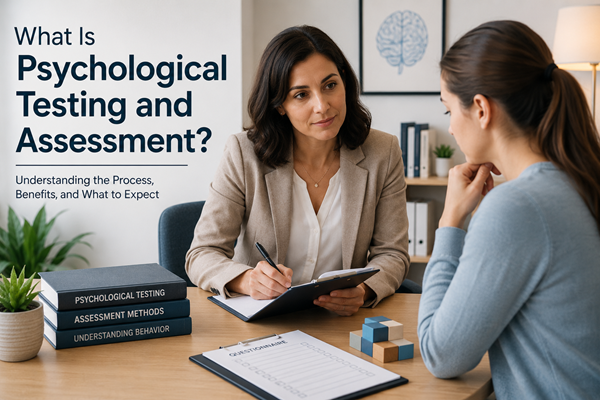
There have been many questions raised about What is Psychological Testing and Assessment? Psychological testing and assessment can be used by a qualified mental health professional to try to understand how a person thinks, feels, behaves and operates in his or her daily life. It can be helpful to know about the symptoms, be able to identify if there are any mental health issues, have an understanding of strengths and challenges, and create a mental health plan.
Psychological Assessment is NOT a questionnaire. Can compile interviews, standard test scores, observations, questionnaires, medical and/or school records, and other relevant information. The aim is to build a profile of the individual and not just a single score or one conversation.
At WellMind Therapy Center, acknowledging your worry is a crucial part of custom-made psychological treatment. In this guide, you will learn about psychological testing and assessment, the reasons for it, some of the tests that may be used, and what to expect when you are undergoing testing and assessment.
Key Takeaways
- Psychological Testing and Assessment: What is it? The systematic approach to learning about a person’s thinking, feelings, actions, skills and performance.
- In the typical psychological testing, standardized instruments test some characteristics or skills.
- Psychological assessment is more comprehensive and could involve tests, as well as interviews, observations, records, and clinical judgments.
- Testing can be a tool to identify or clarify concerns about anxiety disorders, depression, ADHD, PTSD and trauma, personality, cognition, learning and more. .
- A psychological test is not a test that yields a yes or no.
- The examiner must also be qualified and know the indications and limitations of each test to interpret the results.
- A comprehensive assessment may be beneficial in the diagnosis, recommendations, and creation of the care plan for a specific child.
What Is Psychological Testing and Assessment?
What is Psychological Testing and Assessment? Simply put, it is a professional procedure of obtaining information regarding an individual’s psychological functioning. It can assist with addressing specific questions relating to emotion, behavior, thinking, personality, memory, attention, learning or other functioning areas.
The term psychological testing is appropriate for standardized instruments as it is for Norman. These may be questionnaires, rating scales, cognitive tests, personality questionnaires or any other type of structured assessment. Standardized tests have been created to ensure that they are given and graded the same across all test takers.
The psychological assessment is more detailed through a formal psychological evaluation. It may include:
- A clinical interview
- Standardized psychological tests
- Questionnaires and rating scales.
- Behavioral observations
- Taking personal/family history into account.Reflecting on individual/family experiences.
- School / work information
- Relevant medical records
- Where appropriate and agreed, information from family member(s) or other source.
Therefore, in asking What is Psychological Testing and Assessment? remember one simple difference: Testing is part of the process of making an assessment, and assessment is the gathering of a variety of sources.
The process will differ from person to person and depending on what questions the professional may be asking.
Why Is Psychological Testing Important?
Knowing what psychological testing and assessment is all about is crucial because symptoms of mental disorders can be similar. Difficulty concentrating/distributing – may be associated with ADHD, anxiety, depression, sleep problems, stress, side effects of medications and other problems.
Likewise, there could be several reasons for mood swings. If someone carefully assesses a symptom, for example, it helps them to think outside the box with the help of a licensed mental health practitioner.
Psychological testing can aid:
- Clarify symptoms
- Offer aid or disagreement to possible diagnosis
- Assess for cognitive/learning impairments
- Understand emotional functioning
- Explore personality characteristics
- Evaluate attention, memory capacity.
- Look for strengths and supports needed.
- Make recommendations and provide care plans
- Allocate baseline for comparison in the future
Testing and other assessments are used by psychologists to measure and monitor behaviour, for diagnosis making and to help provide care.
Never read the test result without considering the other factors. The importance of a professional interpretation is that the scores have to be understood and interpreted in relation to the individual’s past and concerns, his/her surroundings and other information.
What Are the Different Types of Psychological Tests?
No one test fits all. These tools will differ according to the person’s age, concern, history and questions that are evaluated.
Common categories include:
1. Personality Tests
1. Personality Tests
Personality assessments focus on characteristics of thought, feelings, relationships and actions that are consistent. Some contain questionnaires and others have other formats. They could help a specialist to understand basic personality traits, emotional patterns, or evaluate complex conditions like borderline personality disorder (BPD) or narcissistic personality disorder (NPD).
2. Cognitive and Intellectual Tests
Cognitive testing can look at reasoning, problem-solving, memory, attention, processing and more.
These tests are useful when someone might be concerned that he or she has problems concentrating, learning, remembering, or thinking.
3. Achievement and Learning Tests
Assessments may measure the knowledge and learning skills (reading, writing, mathematics or other) that impacts your academic work. These usually are used if a child or student is having difficulties in school.
4. Neuropsychological Tests
Neuropsychological testing examines the impact of varying brain functions on thoughts and behaviors more in-depth. May pay attention to memory, language, attention, executive functioning, problem solving.
5. Clinical or Symptom Measures
These questionnaires can assess symptoms of anxiety, depression, trauma and other mental health concerns. Screening tests provide useful information but a diagnosis cannot be made based on a screening test alone.
6. Behavioral Assessments
Professionals can use behavioral information to help them understand patterns that can occur at home, school, work, or in relationships.
There are many assessment areas represented by the American Psychological Association including anxiety/depression, cognition, intelligence, personality, trauma, and mental health and neuropsychological functioning.
What Does a Psychological Assessment Evaluate?
Another good question would be What is Psychological Testing and Assessment? and another one is what does it examine?
The assessment can assess:
- Feeling, experiencing and expressing emotions.Emotional and mood reactions.
- Anxiety and worry
- Depression symptoms
- Attention and concentration
- Memory
- Learning abilities
- Reasoning and problem-solving
- Personality traits
- Social and interpersonal functioning
- Behavioral patterns
- Trauma-related symptoms
- Substance use disorder concerns
- Daily functioning
- Identifying strengths and weaknesses in learning.
The assessment may also cover how symptoms affect relationships, school, work, sleep and responsibilities, and affect daily functioning.
An important point: It’s NOT about naming someone. This is so that relevant information can be gathered that may help to understand what the person may be experiencing and what kind of support may be needed.
What to Expect During a Psychological Assessment
Knowing what psychological testing and psychological assessment entails will help alleviate the fear of the unknown.
The first often is to find out why they are asking for the assessment. Your psychologist may inquire about your concerns, your background, family background, school background, work experience or past mental health experiences.
You can then fill in one or more questionnaires or structured tests.
You may be required to (based on the assessment):
- Respond questions about the person else’s thoughts and feelings.
- Discuss recent or past problems
- Complete written questionnaires
- Solve reasoning questions, or problems.
- Complete sentences and phrases
- Discuss your own or family’s history.
- Be ready to take part in a clinical interview
- Provide relevant records, when needed
There’s seldom something to “study.It’s not a topic that’s studied often. Psychological testing is not a test in school and there is no right or wrong personality.
The professional will use the information to decide the purpose(s) of the assessment and relevant standards of comparison.
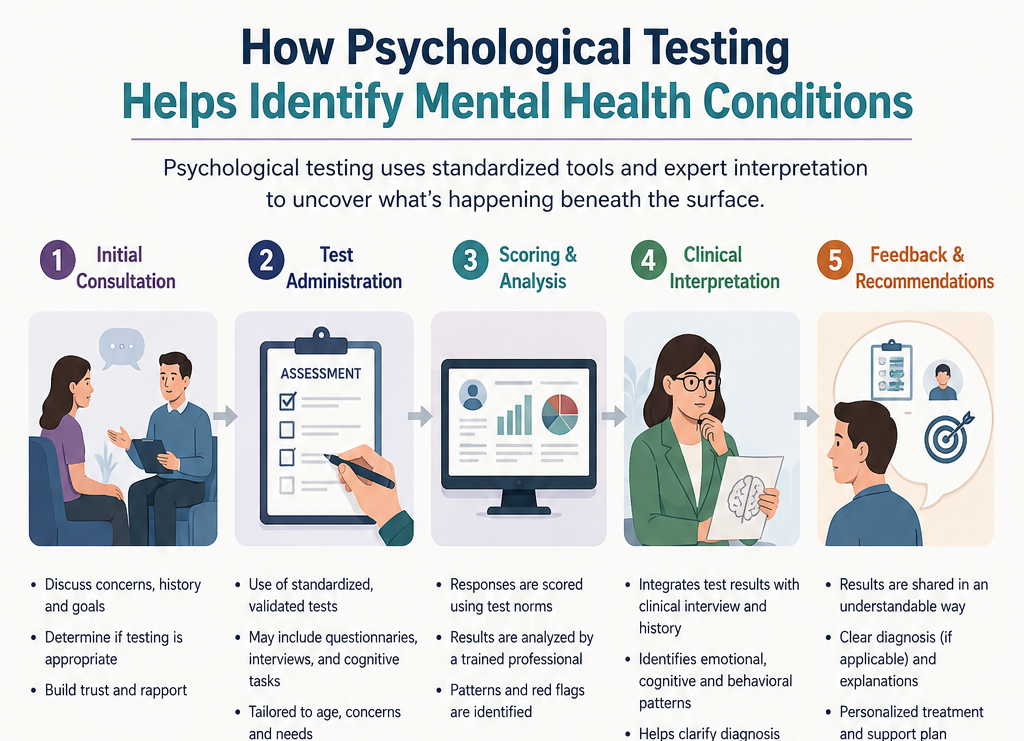
A Simple 7-Step Overview
The main steps in psychological assessments are as follows (may vary depending on the process):
- Set up a main concern/referral question.
- Collect information and background.
- Do a clinical interview.
- Select appropriate assessment items.
- Administer assessments and collect additional information.
- Interpret and synthesize the results.
- Discuss Outcomes and Recommendations.
APA defines Assessment as an ongoing process involving the collection of information, professional judgment, interviews, observation and psychometric assessment tools, and used to support decision-making.
How Psychological Testing Helps Identify Mental Health Conditions
Psychological Testing and Assessment, What is it? It’s not simply a diagnosis. Instead, it can give a professional a structured information that gives him/her an idea if the symptoms are related to a specific clinical picture or not.
For instance, an assessment can be used to consider issues such as:
- Anxiety disorders
- Depression
- ADHD
- Trauma-related conditions and PTSD
- Personality disorders such as BPD or NPD
- Learning difficulties
- Cognitive concerns
- Substance use disorders
Typically, more than one test is required for a mental health diagnosis. A professional takes into account symptoms, length of time, severity, functioning, history and other factors. Due to medical conditions and/or medication effects, sometimes symptoms can be similar to mental health issues, which may require a more comprehensive evaluation.
This is one of the reasons it is not appropriate to restrict What is Psychological Testing and Assessment? to “taking a mental health test. An appropriate evaluation is an assessment that is holistic in nature with respect to the person.
Ready to Better Understand Your Mental Health?
If you are having a difficult time with mood, anxiety, attention, emotional upset, behavioral issues, or don’t know what is happening with you, you don’t have to know it all by yourself.
WellMind Therapy Center can help you make a step towards the understanding of your mental needs. Call WellMind Therapy Center and discuss your concerns and determine whether or not a psychological test or evaluation is needed.
You can talk with a professional to find out what you need to know and what type of evaluation might be right for you.
Who Can Benefit From Psychological Testing and Assessment?
Psychological Testing & Assessment – What is It? A process that can be beneficial for all ages and concerns.
It may benefit:
- Children with learning problems (or behaviour problems)
- Adolescents who struggle to pay attention, control emotions and/or school behaviour.
- Adults that are anxious, depressed or concentrating problems
- People who are concerned about their memory or thinking.
- People who are seeking some reason for their problem.People who want to know if they are suffering from something that they think they are.
- Those who do not have a well-defined expression of their symptoms.
- Individuals who need information to help them make decisions about their mental health services.
Assessment can also be utilized to identify strengths. Sometimes it’s just as important to know what someone is good at as to know what he or she needs help with.
Sometimes, a child can get relevant information from the information given by parents, teachers and records recorded in the school. Medical history and daily functioning, work history and relationships can complete the picture for adults.
When Should You Consider Psychological Testing?
If you’re still asking yourself What is Psychological Testing and Assessment? then consider it a series of questions that will help you answer about your mental and emotional performance.
If you want to talk about an assessment, then if you:
- Your symptoms last longer than usual or aren’t easily understood.
- Don’t know whether the symptoms represent anxiety, depression, ADHD, trauma or other problem.
- Persistent attention, memory, and/or learning difficulties.
- Relationships, school, work or daily responsibilities are being impacted by your emotions or actions.
- In the past your worries weren’t effectively solved.
- You prefer to learn about your strengths and challenges in greater detail.
- You have been referred for an assessment by a health care professional.
It’s a personal choice, test only if completed. A professional will be able to let you know what tools may assist you and what information you might receive by using those tools.
To summarize What is Psychological Testing and Assessment? A systematic procedure for gathering and clarifying psychological data of an individual. Testing is a single data gathering tool, while assessment is a composite of the four data gathering tools, which are tests, interviews, observations, history, and professional judgment.
When performed properly, the procedure can provide useful insights to help with diagnosis, recommendations, and individual mental health treatment. More significantly, it can help alleviate the uncertainty with a better insight into what someone might be feeling.
Frequently Asked Questions
What is the meaning of psychological testing and assessment?
Psychological Testing involves the use of standardised instruments to assess one’s psychological characteristics or abilities. Psychological assessment is more comprehensive and integrates test scores with interviews, observations, history and other data to gain a broader perspective of a person’s functioning.
What are the 7 steps of psychological assessment?
The seven common steps involve: defining the referral question, obtaining history, conducting an interview, choosing tests, administering tests, synthesizing results, discussing results and recommendations. The process is slightly different for each person.
What are the four main types of psychological tests?
There are four general types of tests: personality tests, cognitive (intelligence) tests, achievement (learning) tests, and clinical (symptom) tests. Other evaluations can include memory, neuropsychological functioning, behavior, trauma, or other specific issues.
What is the difference between assessment and testing?
Typically, testing involves giving a standardized psychological measure of a particular skill, characteristic, or symptom. Assessment is an umbrella term that includes a blend of test results, interviews, observations, history and professional judgment.
What are three types of assessments?
There are three major methods of assessment, namely, clinical, psychological and neuropsychological. The type used will vary depending on the question being answered. Several methods are used in some evaluations to provide a more comprehensive picture.
What is the fundamental difference between psychological testing and psychological assessment?
Psychological tests are concerned with the standardized measurement with a particular tool. Psychological evaluation involves the entire process of combining test scores and other data sources (interviews, observations, history, etc.) with the goal of arriving at meaningful conclusions and recommendations.
Disclaimer
The information provided in this article is for educational and informational purposes only. It is not a replacement for professional psychological evaluation, diagnosis, medical advice or individual care. Psychological testing should be used by qualified professionals to be selected, administered, scored and interpreted. The effects on people are individual and will vary on each person. When you are in serious pain or feel there is an immediate danger, please contact a healthcare professional or emergency services.
References and Authoritative Sources
- American Psychological Association (APA): Understanding Psychological Testing and Assessment — explains the difference between psychological testing and assessment and how psychologists use these tools.
American Psychological Association: Understanding Psychological Testing and Assessment - American Psychological Association: Testing, Assessment, and Measurement — provides information about standardized psychological tests and areas they may measure.
APA Testing, Assessment, and Measurement - American Psychological Association: APA Guidelines for Psychological Assessment and Evaluation — provides professional guidance on psychological assessment and testing.
APA Guidelines for Psychological Assessment and Evaluation - MedlinePlus: Mental Health Screening — explains mental health screening, what it evaluates, and why additional evaluation may sometimes be needed.
MedlinePlus: Mental Health Screening - National Institute of Mental Health (NIMH): Mental health information and guidance on understanding symptoms and seeking professional care.
National Institute of Mental Health
Content review note: This blog has been written and proofread for clarity, accuracy, plain-language readability, search intent, and responsible mental health communication. It avoids presenting psychological tests as standalone diagnostic tools and emphasizes professional interpretation.