Addiction Statistics 2026 – Facts On Drug And Alcohol Use
The use of drugs and alcohol in America is slowly changing. There has been a decrease in drinking, binge drinking, smoking, and addiction since 2021, particularly for teenagers and young adults. Meanwhile, marijuana use has also increased among adults aged 26+, and in the case of marijuana, so has vaping nicotine. There are more people out there recovering than you think.
According to the latest addiction statistics, more than half of Americans aged 12 and older used alcohol, tobacco, nicotine vapes, or illegal drugs in the past month. Approximately 15.3% had a substance use disorder. The good news is that 73% of all adults with a drug or alcohol addiction have reported that they are now recovered or in recovery.
Headlines typically feature the most negative statistics. That makes sense, since overdoses and alcohol deaths are real tragedies. However, thinking only in terms of damage can be hopeless, but it isn’t.
Wondering where your drinking or drug use fits these trends? WellMind Therapy Center offers confidential assessments at (682) 432-1571.
What Percentage of Americans Use Drugs or Alcohol?
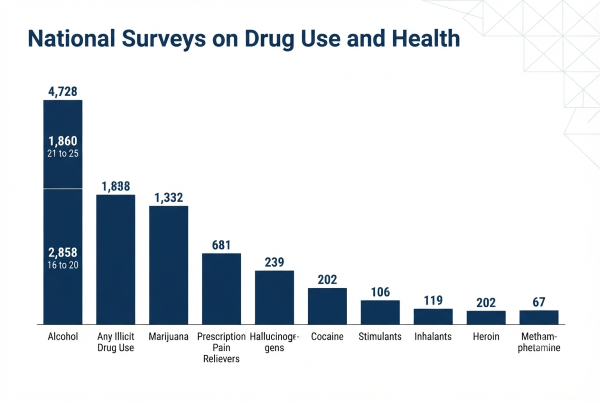
About 56% of Americans aged 12 and older, or 162.8 million people, used some substance in the past month in 2025. Alcohol led by far with 129.1 million users. Tobacco products followed at 46.9 million, then marijuana at 43.8 million and nicotine vaping at 29.3 million people.
| Past-Month Use, Ages 12+ (2025) | People | Share |
| Any alcohol, nicotine, or illicit drug | 162.8 million | 56.0% |
| Alcohol | 129.1 million | 44.4% |
| Tobacco products | 46.9 million | 16.2% |
| Marijuana | 43.8 million | 15.1% |
| Nicotine vaping | 29.3 million | 10.1% |
| Any illicit drug | 47.5 million | 16.4% |
Source: SAMHSA 2025 National Survey on Drug Use and Health
Use alone is not an addiction. Most people who drink do not have alcohol use disorder. Addiction begins when use becomes hard to control and keeps causing harm.
How Has Addiction Changed Since 2021?
Addiction rates have fallen since 2021. Substance use disorder dropped from 16.7% of people aged 12 and older in 2021 to 15.3% in 2025. Alcohol use disorder fell from 10.6% to 8.9%. Cigarette smoking also declined. Marijuana use and nicotine vaping moved in the opposite direction, mostly among adults.
| Five-Year Trend, Ages 12+ | 2021 | 2025 | Direction |
| Any substance use disorder | 16.7% | 15.3% | Down |
| Alcohol use disorder | 10.6% | 8.9% | Down |
| Past-month cigarette smoking | 16.0% | 12.4% | Down |
| Past-month binge drinking | 21.7% | 19.5% | Down |
| Past-month marijuana use | 13.2% | 15.1% | Up |
| Past-month nicotine vaping | 8.3% (2022) | 10.1% | Up |
These addiction statistics suggest real progress. Still, 44.6 million people living with a substance use disorder is not a small number.
Feel like your habits are slipping? WellMind Therapy Center can help you find the right starting point: (682) 432-1571.
Which Age Group Is Most Affected by Addiction?
Young adults aged 18 to 25 have the highest rates of marijuana use, binge drinking, and nicotine vaping. Adults 26 and older have the most drinkers overall and are rising in marijuana use. Teens aged 12 to 17 have the lowest rates of every major substance, and most of their rates are still falling.
| Past-Month Use (2025) | Ages 12 to 17 | Ages 18 to 25 | Ages 26+ |
| Alcohol | 5.9% | 46.2% | 48.4% |
| Binge drinking | 3.0% | 26.7% | 20.2% |
| Marijuana | 5.0% | 23.3% | 14.9% |
| Nicotine vaping | 6.3% | 22.3% | 8.6% |
| Cigarettes | 1.3% | 9.8% | 14.1% |
Adults 26 and older are the only group where past-month marijuana use rose between 2021 and 2025, climbing from 12.3% to 14.9%. Illicit drug use in this group also increased, from 20.5% to 23.5% over the past year.
Adults over 26 often get overlooked in addiction conversations. Parents, spouses, and working professionals are part of these numbers too.
How Early Do Americans Start Using Substances?
Most people try alcohol and nicotine young. In 2025, about 4.3 million people drank alcohol for the first time, and 70.1% of them were under 21. Another 4.2 million people vaped nicotine for the first time, and 2.4 million first tried marijuana. Cigarette initiation rose among young adults.
| First-Time Use in 2025 | New Users | Started Before Age 21 |
| Alcohol | 4.3 million | 70.1% |
| Nicotine vaping | 4.2 million | 35.9% |
| Marijuana | 2.4 million | Not reported |
| Cigarettes | 1.7 million | 65.7% |
Among young adults aged 18 to 25, first-time cigarette use climbed from 2.2% in 2021 to 3.2% in 2025. That reverses a long decline and deserves close attention.
Expert Advice: Ask about treating anxiety or depression alongside substance use, not separately.
Are Teens Using Fewer Drugs and Alcohol?
Yes. Teen substance use fell across most measures between 2021 and 2025. Past-month alcohol use among 12 to 17-year-olds dropped from 7.2% to 5.9%, and past-year illicit drug use fell from 14.6% to 11.2%. First-time marijuana use among teens also declined, from 3.5% to 2.4%.
Some risks remain stubborn. Among underage people aged 12 to 20, binge drinking showed no significant change, holding at 7.9% in 2025. That equals about 3.1 million young people.
SAMHSA research insight: In 2025, adolescents aged 12 to 17 and young adults aged 18 to 25 continued showing downward or stable trends in most behavioral health indicators, building on gains first seen in 2024, according to the SAMHSA 2025 NSDUH release.
Is Vaping a Growing Addiction Problem?
Nicotine vaping is growing among adults, even as it levels off among teens. The share of people aged 12 and older who vaped nicotine rose from 8.3% in 2022 to 10.1% in 2025. The biggest jump came from adults 26 and older, whose vaping rate climbed from 6.0% to 8.6%.
Among underage people aged 12 to 20, 10.6% vaped nicotine in the past month. Only 3.4% smoked cigarettes. For this generation, vaping has replaced cigarettes.
How Many Americans Recover From Addiction?
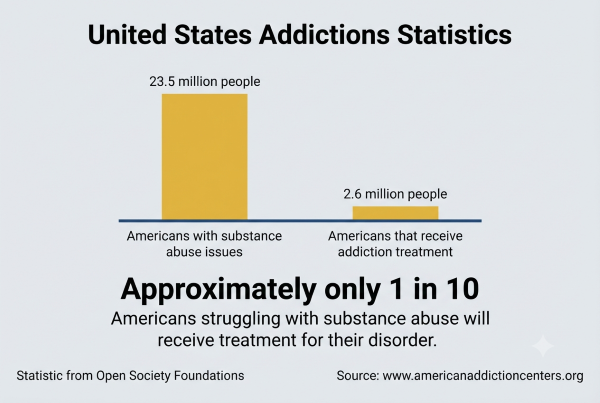
Most do. Recovery is the most hopeful of all addiction statistics. In 2025, 73.0% of adults who ever had a drug or alcohol problem, or 22.3 million people, considered themselves recovered or in recovery. That makes recovery the most common outcome of addiction, not the exception. Yet only 1 in 6 people who needed treatment in 2025 received it.
| Recovery and Treatment (2025) | Number |
| Adults in recovery or recovered | 22.3 million (73.0%) |
| People who needed SUD treatment | 47.2 million |
| People who received treatment | 7.6 million (16%) |
SAMHSA’s 2024 recovery report found that young adults aged 18 to 25 had lower odds of recovery than adults 50 and older. Younger people may need more structure and support to reach lasting change.
CDC research insight: Alcohol-related deaths rose 35% among girls and women between 2016-2017 and 2020-2021, compared with 27% among boys and men, according to the CDC. The gap between genders is narrowing.
From our clinical team at WellMind Therapy Center: Recovery statistics permit people to hope. Lasting change usually comes from treating the stress, trauma, or mood symptoms underneath the substance use.
How Often Do Addiction and Mental Health Problems Overlap?
Very often. Research summarized by the National Institute on Drug Abuse shows that about half of people who experience a mental illness during their lives will also experience a substance use disorder, and the reverse is also true. Anxiety, depression, and trauma frequently sit underneath drinking or drug use.
The 2025 federal survey shows how common mental health struggles are on their own. About 63.8 million adults, or 24.3%, said they had ever had a problem with their mental health. Of those, 69.4% considered themselves recovered or in recovery.
| Recovery Comparison (Adults, 2025) | In Recovery or Recovered | Share |
| Drug or alcohol problem | 22.3 million | 73.0% |
| Mental health problem | 44.1 million | 69.4% |
When both conditions exist together, treating only one rarely lasts. Integrated care addresses the substance use and the mental health condition at the same time.
Fact: 73% of adults who ever had a substance problem consider themselves recovering.

Addiction Treatment in Fort Worth at WellMind Therapy Center
WellMind Therapy Center in Fort Worth, Texas, provides structured outpatient care for adults 18 and older living with substance use disorders, mental health conditions, or both. Its care is trauma-informed and collaborative.
WellMind Therapy Center focuses on care that fits real life. There is no overnight stay, and clients return home each evening:
- Partial Hospitalization Program (PHP): About 25 treatment hours per week over five days, for adults who need daily structure and support.
- Intensive Outpatient Program (IOP): 9 to 15 hours per week, two to four days a week, so clients can keep up with work, school, or family.
- Substance use disorder treatment: Group counseling, relapse prevention planning, recovery skill building, family support, and dual diagnosis care.
- Medication management: Led by board-certified psychiatric mental health nurse practitioners.
Programs draw on CBT, DBT, Acceptance and Commitment Therapy, Somatic Experiencing, and Internal Family Systems. WellMind Therapy Center also offers psychological testing for adults for people seeking diagnostic clarity, family therapy, and alumni support after programs end.
The intake team can verify insurance benefits before you begin. Call (682) 432-1571 or visit the contact page to schedule an assessment.
Frequently Asked Questions
What are the latest addiction statistics for 2026?
The latest federal data shows that 44.6 million Americans aged 12 and older, or 15.3%, had a substance use disorder in 2025. This was lower than the 16.7% reported in 2021. SAMHSA released these figures in July 2026 as part of its latest National Survey on Drug Use and Health.
How many Americans are in recovery from addiction?
In 2025, approximately 22.3 million American adults considered themselves recovered or in recovery from a substance use problem. This represented about 73% of adults who reported ever having a problem with their drug or alcohol use. Recovery is individually defined, so these figures reflect respondents’ own understanding of recovery.
Is teen drug and alcohol use going down?
Yes. Federal survey data shows that several forms of substance use among adolescents have declined. Between 2021 and 2025, past-month alcohol use fell from 7.2% to 5.9%, while past-year illicit drug use decreased from 14.6% to 11.2%. These trends indicate lower reported substance use among teens overall.
Are young adults more likely to struggle with substance use?
Young adults aged 18 to 25 have relatively high rates of several types of substance use. However, recent federal data shows declines in many measures for this age group. In 2025, young adults continued to report substantial levels of alcohol, marijuana, nicotine vaping, and illicit drug use compared with other age groups.
How many people start drinking alcohol each year?
In 2025, approximately 4.3 million Americans aged 12 and older reported drinking alcohol for the first time during the previous year. About 70% of these new alcohol users were younger than 21. Early alcohol exposure can increase concerns about underage drinking and potential problems with alcohol later in life.
Is nicotine vaping increasing?
Nicotine vaping has increased among some adult groups. Past-month vaping among adults aged 26 and older rose between 2022 and 2025, contributing to an overall increase among adults. However, vaping among young adults aged 18 to 25 declined during this period, showing that trends differ considerably by age group.
How common is underage binge drinking?
In 2025, approximately 3.1 million people aged 12 to 20 reported binge drinking during the past month, representing about 7.9% of this age group. Although underage binge drinking remains a concern, federal data indicates that drinking patterns among adolescents and young adults have generally declined over time.
Are more adults using marijuana than before?
Marijuana use has increased among some older adults. Among people aged 26 and older, past-month marijuana use rose from 12.3% in 2021 to 14.9% in 2025. However, marijuana use declined among adolescents and young adults during the same period, showing that trends vary substantially across age groups.
Is addiction considered a disease?
Yes. Major medical organizations, including the National Institute on Drug Abuse, describe addiction as a treatable medical condition involving changes in brain function and behavior. Substance use disorders can be chronic and recurring, but evidence-based treatment, recovery support, and ongoing care can help people manage symptoms and improve functioning.
How many Americans use some kind of substance each month?
In 2025, approximately 162.8 million Americans aged 12 and older, or 56% of this population, reported using alcohol, tobacco, nicotine vaping products, or an illicit drug during the past month. Alcohol accounted for the largest share of this overall substance-use estimate, according to SAMHSA’s national survey.
References
- https://www.cdc.gov/alcohol/facts-stats/index.html
- https://www.cdc.gov/alcohol/excessive-drinking-data/index.html
- https://nida.nih.gov/publications/drugs-brains-behavior-science-addiction/treatment-recovery
- https://nida.nih.gov/drug-topics/mental-health
This article is for informational purposes only and should not replace professional medical advice, diagnosis, or treatment. If you or someone you know is struggling with substance use, contact WellMind Therapy Center or visit WellMind Therapy Center to learn about available treatment options.