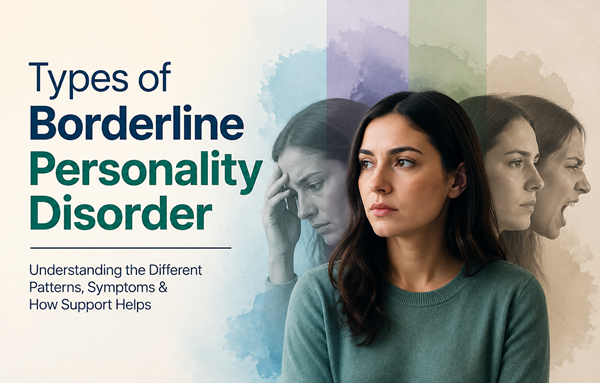
Types of Borderline Personality Disorder: A Complete Guide
If you’ve been researching the types of borderline personality disorder, you may have heard of the four types of BPD or subtypes. These classifications may provide a notion of the different components of borderline personality disorder (BPD) that people may display.
However, a note of caution: The four common types are not acknowledged as entitling a diagnosis in the DSM-5-TR. Rather, they are types that are assumed and that some mental health workers use as a guide to assist in identifying marked individual patterns of symptoms and behaviors.
Understanding the difference gives insight into how one can recognize BPD without giving it labels. WellMind Therapy Center prioritizes a comprehensive approach to therapies, acknowledging that each individual is unique and developing a customized mental well-being method.
Key Takeaways
- Three of the most popular forms of BPD (Borderline Personality Disorder) discussed include “discouraged,” “impulsive,” “petulant,” and “self-destructive.”
- These four subtypes are based on the theoretical framework of Theodore Millon, and are not included in the diagnosis of the DSM-5-TR.
- All people who have BPD are unique. Patterns can be overlapping, and symptoms can be present in more than one pattern.
- Some of the symptoms of BPD include extreme emotionality, poor or fluctuating relationships, impulsiveness, fear of abandonment, and a fluctuating self-image.
- BPD can only be diagnosed by a mental health professional trained in this area.
- There is support available, and it will likely be of benefit. Psychotherapy is the main treatment, and several structured psychotherapies can be effective in decreasing symptoms and enhancing functioning.
What is Borderline Personality Disorder?
BPD is a mental health illness which impacts on mood, relationships, self-perception, and behavior. Those who suffer from BPD tend to feel emotions intensely, and sometimes they fluctuate rapidly.
Some examples would be that perhaps one is very pleasant to another but then turns off or becomes angry as a result. Another person might have a problem with impulsiveness, and another person might bottle up his or her distress.
An attempt at a description of such differences is related to the nature of BPD.
According to the National Institute of Mental Health (NIMH), the following are signs of BPD: emotional regulation, impulsivity, fluctuations in sense of self and relational issues. Depression, anxiety, PTSD, substance use disorders and other conditions also can be present with symptoms.
However, it is not BPD to be “too emotional” or to experience problems in relationships. It is a known mental illness that can lead to a lot of distress and to problems in life.
How are the Types of Borderline Personality Disorder Different?
The four primary types of borderline personality disorder have been believed to be associated with a theory of the psychologist Theodore Millon. They might be subcategorizations of BPD but are not four distinct types of BPD.
Discouraged Borderline
The discouraged type could relate to a feeling of insecurity, rejection, sadness and reliance on others.
Someone who has this pattern might:
- Experience rejection and/or not being wanted.
- Strongly fear abandonment
- Not be afraid to seek lots of reassurance.
- Have low confidence
- Withdraw when overwhelmed
- Lack of persistence: don’t feel sad or feel like a failure any longer
This can be considered a trait pattern of avoidance or depression.
Impulsive Borderline
Impulsive is someone prone to rash actions who don’t consider the consequences.
Possible behaviors include:
- Risky decisions
- It’s not worth spending too much funds.
- Substance misuse
- Planned change that occurs in plans.
- Reckless behavior
- Strong emotional reactions
Impulsivity can offer temporary alleviation from challenging emotions, and can lead to further issues later on.
Petulant Borderline
The petulant type could be some combination of emotional sensitivity, frustration, anger and mistrust.
- An individual who has this pattern might
- Get upset if things don’t happen as you want them to
- Feel misunderstood
- Alternate dependent/independent roles.
- Take turns between alternate dependence and independence.
- May be unable to express needs clearly; May be feeling upset if needs and boundaries are crossed
- Become angry when feeling ignored
- Struggle with resentment
Not that the goal here is to be difficult to please! Conflict situations can seem more heightened if there are distress feelings involved.
Self-Destructive Borderline
The destructive type is linked to a self-reflective and self-absorbed personality.
- Any of these features may be
- Severe self-criticism
- Feelings of worthlessness
- Social withdrawal
- Self-defeating behaviors
- Persistent emotional pain
Some might feel compelled to injure themselves and, at worst, contemplate suicide.
BPD can also include self-harm and thoughts about suicide, so be sure to take care of those with a trained professional. If another person is in immediate need of help, or might be able to commit suicide on their own, emergency help should be called.
Are These Really Four Different Disorders?
No. One of the most crucial considerations while discussing the types of borderline personality disorder is that.
These four descriptions are not to be used as diagnostic entities, but as patterns and/or theoretical subtypes. Current practice focuses on the pattern and severity of the BPD symptoms instead of the four types of BPD. The American Psychiatric Association (APA) does not recognize four personality disorders of BPD rather it defines BPD as one personality disorder.
It should be noted that some people may have symptoms of two or more subtypes.
Common Symptoms Across Borderline Personality Disorder Types
The classifications of borderline personality disorder can vary, but there are some common characteristics.
Common symptoms are:
- Strong or fast shifts of feeling or emotion
- A strong fear of being abandoned.
- Complex or difficult relationships
- Not having an identity or changing one’s identity
- Impulsive behavior
- Intense ange
- Feelings of emptiness
- Self-harming behavior
- Ideation or suicidal ideation – those thoughts or actions that would lead to suicide.
- High level of suspicion and/or separation when short-term stressed out
Individuals with BPD might have intense fluctuations in their self-perception and perception of others, according to the NIMH. Sometimes relationships can go in and out of extremes of closeness and extreme conflict.
Only some of the symptoms will come about in each person. Symptoms can be mild, moderate, or serious and happen one time or multiple times.
This is why it’s important not to base your opinion on an online list of what types of borderline personality disorder are like, rather than a clinical evaluation.
What Causes Borderline Personality Disorder?
No one cause of BPD. It has been suggested that it is developed by several factors.
These may include:
- Biological or genetic factors.
- Differences in emotional control.
- Environmental stress
- Difficult childhood experiences
- Unstable relationships
- Trauma or neglect
- A family history of mental health problems.
If one has one of these experiences, it does not imply that one will develop BPD. Likewise, someone can suffer from BPD but not have all of the factors that are usually referred to.
The NIMH is researching how biology, genetics, differences in the brain and environmental factors play a role in the development of BPD.
Don’t blame a family or the individual. BPD is not a single incident and is complex.
How is Borderline Personality Disorder Diagnosed?
There is no one definitive blood test, scan, or laboratory test to confirm BPD.
An experienced mental health practitioner will take into account:
- Signs and concerns that occur at this time
- Personal and family mental health record.
- Relationship patterns
- Changes in mood or actions.
- Patients’ reports of symptoms in their everyday lives
- Other mental health disorders
- Risk of self or others being harmed
- Physical health problems that can affect symptoms
The NIMH says that diagnosis of BPD entails a lot of conversation about symptoms, as well as personal and family history. A physical exam also will rule out other causes.
It can be challenging to diagnose since BPD shares some symptoms with other disorders such as bipolar disorder, depression, anxiety disorder, PTSD and substance use disorders.
For example, mood swings are a potential symptom of both BPD and bipolar disorder. But these are not the symptoms of BPD that are the same as bipolar disorder’s totally different manic/hypomanic episodes.
So it’s best to refrain from self-diagnosis and take the time to read the information online about the different kinds of BPD.
How is Borderline Personality Disorder Treated?
The positive news is that BPD is treatable and symptoms can improve greatly.
The main treatment is psychotherapy. Evidence-based treatments may lead to fewer or less severe symptoms and improved functioning and quality of life, according to the NIMH.
Common solutions could be:
Dialectical Behavior Therapy
Dialectical Behavior Therapy (DBT) is a therapy that was developed for individuals who have extreme emotional and behavioral problems. Can show you ways to use effective strategies and tools that are successful in the real world to help you to manage your emotions, tensions, and relationships and reduce negative behaviors.
Cognitive Behavioral Approaches
CBT methods can assist individuals in identifying negative thoughts and figuring out how to change their reactions to challenging scenarios.
Mentalization-Based Therapy
MBT helps to understand a person’s own thoughts, feelings, and intentions, and those of another person’s thoughts, feelings, and intentions.
The new guideline by the American Psychiatric Association (APA) recommends a treatment which requires a plan of an evidence-based psychotherapy plan for BPD. Another key aspect is the evaluation and development of a treatment plan for the best-fit client treatment.
Drugs are not used in the treatment of core symptoms of BPD as the first line of defense. The qualified prescriber might consider providing some medicine, as needed, for the appropriate symptoms or co-occurring symptoms.
Looking for professional support for borderline personality disorder?
Don’t try to do it alone if the intensity of emotions, issues in relationships, impulsiveness, and other BPD-related behaviors are interfering with life. Please discuss your concerns with WellMind Therapy Center about your mental health needs and how mental health services can support you. A medical professional can help you understand your symptoms and what you should do next.

When Should You Seek Professional Support?
Consider seeking professional assistance if these emotional and behavioral changes persist, are difficult to cope with, or are interfering with relationships, work, school or life.
Support may be particularly crucial when you have:
- Frequent emotional crises
- Severe relationship conflict
- Repeated impulsive behavior
- Significant continued emptiness
- Strong feelings of fear and rejection.
- Self-harm
- Suicidal thoughts
- Emotional upset, leading to problems getting along
There’s no need to find out which of these types of borderline personality disorder matches you before you seek help. These experiences can be examined by a mental health professional who can help you to understand what’s happening.
With proper treatment, BPD symptoms can get better. Current guidelines of the American Psychiatric Association emphasize whole-person, individualized, evidence-based psychotherapy.
Looking for more?
Call WellMind Therapy Center to talk with a therapist about mental health concerns and receive customized support. Assessment can play a significant role as a starting point to begin dealing with emotions, relationship skill and functioning in daily life.
Frequently Asked Questions
What are the four types of borderline personality disorder?
The four subtypes usually mentioned are discouraged, impulsive, petulant and self-destructive borderline. These categories are based on theoretical models, most notably those developed by Millon, and are patterns, not four formal diagnoses for BPD.
Are the four types of borderline personality disorder officially recognized?
No. No, the four types are not independent diagnosis as listed in the DSM-5-TR. They are a theoretical description which may be helpful in understanding differences in symptoms. Borderline personality disorder is diagnosed according to a set of criteria and the presentation of the person.
Can someone have more than one type of borderline personality disorder?
Yes. These are descriptive patterns, not specific diagnoses, so a person may exhibit characteristics of more than one pattern. Symptoms may also evolve over time, and instead of symptoms, professionals are interested in the individual’s general symptoms and functioning.
What is the most common type of borderline personality disorder?
No single type of BPD is “most common”. Research has identified various patterns, but the four theoretical subtypes are not diagnostic categories, and therefore reliable prevalence rates cannot be provided.
How is borderline personality disorder diagnosed?
BPD is diagnosed by a qualified mental health professional who evaluates symptoms, personal and family history, relationships, functioning and other possible conditions. There are no specific laboratory tests for BPD. An extensive assessment can aid in differentiating between overlapping disorders.
Final Thoughts
Knowing more about the different types of personality disorder on the border can help to understand, that BPD is not the same for all. The vague and unhelpful descriptions of the discouraged, impulsive, petulant and self-destructive patterns can be helpful but they do not constitute four separate official diagnoses.
Symptoms, experiences, safety and goals are all that matter. Individuals with BPD can learn healthier strategies for regulating emotions, enhancing relationships, and enriching life with the right evaluation and evidence-based treatment.
If you or a loved one are experiencing BPD symptoms, you might want to seek help from a professional, such as WellMind Therapy Center.
Disclaimer
This article is for general educational and informational purposes only. It is no replacement for professional diagnosis, medical advice, psychotherapy or emergency care. The descriptions of the BPD subtypes are included for educational purposes and are not meant for self-diagnosis. If you are having a mental health emergency or you are at immediate risk of harming yourself or others, get emergency help or call an emergency number in your area.
References and Content Sources
- National Institute of Mental Health (NIMH): Information on borderline personality disorder, symptoms, diagnosis, risk factors, co-occurring conditions, and treatment.
NIMH — Borderline Personality Disorder - American Psychiatric Association (APA): Current information and clinical guidance regarding the assessment and treatment of borderline personality disorder.
APA — Borderline Personality Disorder Practice Guideline - Peer-reviewed systematic review: Review of proposed clinical subtypes of BPD, including Millon’s four commonly referenced patterns.
Systematic Review of Clinical Subtypes of BPD