Dual Diagnosis vs. Co-Occurring Disorders: Understanding the Difference
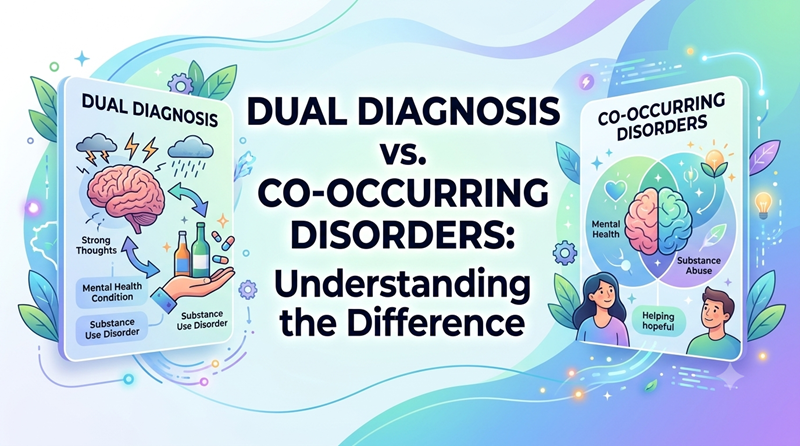
It can be confusing to understand the difference between a dual diagnosis and co-occurring disorders as they are often used to refer to similar circumstances. They both describe someone who has more than one mental health and/or substance use disorder. The terms are similar, but the more prevalent term used in today’s world for the co-occurrence of a mental health disorder and a substance use disorder is co-occurring disorders. Being aware of the differences may help you more easily identify symptoms and access resources.
Often mental health and substance use go hand-in-hand and treating one without the other leaves the other untreated. Alcohol or drug use disorders can co-occur with depression, anxiety, bipolar disorder, PTSD or other mental health disorders. The connection between substance abuse and mental illness is a bi-directional one, with each potentially impacting upon the other, according to the National Institute of Mental Health (NIMH).
Key Takeaways
- The term ‘dual diagnosis’ is now an older term used when a person suffers from both a mental health disorder and a substance use disorder.
- The more up-to-date and preferred term for this combination is co-occurring disorders.
- There are numerous possibilities for co-occurring disorders, such as depression and alcohol use disorder, anxiety and opioid use disorder, bipolar disorder and stimulant use disorder, and many others.
- Symptoms may be overlapping and careful evaluation is crucial.
- The focus of integrated care is on treating mental health and substance use issues together, rather than treating them as separate issues.
- There is a chance to recover, and professional assistance can help the individual understand what’s going on and what to do next.
What Is Dual Diagnosis?
Dual diagnosis is typically used to refer to a situation in which a person has two conditions simultaneously, typically a mental health condition such as depression and a substance use disorder such as a drug addiction.
For instance, a person might suffer from major depression and alcohol abuse. Someone else can have an anxiety disorder and be afflicted with opioid misuse as well.
This was termed a dual diagnosis because it aided workers in describing individuals who were suffering from mental health and substance related issues. The word, however, can at times imply two diagnoses.
In fact, individuals can have more than two conditions. Someone could have depression, an anxiety disorder, and a substance use disorder simultaneously. This is why the more general term co-occurring disorders is used an increasing amount by healthcare professionals.
What Are Co-Occurring Disorders?
A mental health disorder together with a substance use disorder in the same person is referred to as co-occurring disorders.
Co-occurring disorders can be multiple combinations of mental health and/or substance use disorders, not just a mental health disorder and a substance use disorder, SAMHSA defines.
Examples include:
- Depression, alcohol use disorder
- Anxiety and Cannabis use disorder.
- PTSD and Opiate Use Disorder
- Bipolar disorder and stimulant use disorder
- ADHD and alcohol/drug misuse
- Some people have schizophrenia and a substance use disorder.
The key is that both concerns can have an impact on one another. Psychiatric symptoms can be exacerbated by substance use, and substance use can be an attempt to manage psychiatric symptoms.
This doesn’t indicate that if one condition occurs, then so must the other. It can involve a complicated relationship and vary from person to person.
Dual Diagnosis vs. Co-Occurring Disorders: What Is the Difference?
The primary difference between dual diagnosis and co-occurring disorders is usually simply the terminology used.
The term dual diagnosis is an older term frequently used to refer to a person who has two diagnoses, often a mental health disorder and a substance use disorder.
The current and more general term for co-occurring disorders. Acknowledges that there is a possibility of having more than one mental health and/or substance use disorder.
So, is it the same?
Yes in many cases. A dual diagnosis person can also be referred to as a person with co-occurring disorders.
The newer terms are sometimes preferred as they do not suggest that every person has just two conditions. It also focuses the attention of learners more on the interaction of the conditions.
It does not simply aim at determining what label to use. The key question is: What factors are influencing this person’s life, and what kind of help is required?
What Conditions Can Occur Together?
There are a myriad of possibilities. Substance use disorders can be accompanied by other common mental health disorders such as:
- Depression
- Anxiety disorders
- Bipolar disorder
- PTSD
- ADHD
- Schizophrenia
- Personality disorders
Common material include:
- Alcohol
- Opioids
- Cannabis
- Cocaine
- Stimulants (such as methamphetamine)
- Prescription medications
- Nicotine
It doesn’t mean that a person needs to use substances every day to develop a substance use disorder. How a pattern affects, how out of control it becomes and the consequences that result are more important than the frequency of use.
Likewise, mental health symptoms can be quite different in terms of their severity. Someone can have severe symptoms and still go to work, school, and have relationships.
Common Signs of Dual Diagnosis and Co-Occurring Disorders
Identifying co-occurring disorders can be challenging, as symptoms can overlap.
The following are just some of the common symptoms:
- Sadness or hopelessness that last for more than two weeks.
- Worry, anxiety, or fear that is excessive
- Major changes in sleep
- Significant mood swings
- Difficulty concentrating
- Social withdrawal
- Increased substance use
- Relieving emotions with alcohol or drugs
- Attempt to quit but failure to.
- Neglecting responsibilities
- Relationship problems
- Variations in work or school performance
- Experiencing withdrawal symptoms
- Using drugs or alcohol even though it causes problems
Here’s one important hint: a recurring cycle. For instance, a person might get anxious and then drink to make them feel better and feel better for a short time before feeling more anxious later.
Both problems can be made more difficult to control with this pattern.
What Causes Co-Occurring Mental Health and Substance Use Disorders?
There is no one cause.
Genetics, brain functioning, stress, trauma, environment, and life experiences are all thought to play a role in both mental health and substance abuse disorders.
In some cases, mental health signs and symptoms emerge first and the person starts using substances to manage. A person who suffers from extreme anxiety, for instance, might use alcohol to ease some of those uneasy sensations.
At other times, using substances can lead to changes in mood, sleep, thinking or behavior. Heavy and prolonged use of some substances may cause or aggravate the psychiatric symptoms.
Common risk factors may also exist. Other trauma, chronic stress, family history, social instability or other factors can make a person vulnerable to more than one condition.
Asking the question, “Which problem came first?” is rarely helpful unless you see the bigger picture.
How Are Dual Diagnosis and Co-Occurring Disorders Diagnosed?
There is no single test that can identify co-occurring disorders.
The initial evaluation is usually conducted by a mental health expert. It could contain questions on:
- Current symptoms
- Mood and behavior
- Alcohol and drug use is not permitted.
- Prescription medications
- Family history
- Previous diagnoses
- Experiences of trauma and stress
- Sleep
- Relationships with work, school, and others
- Previous history of mental health services.
- History of drug or alcohol use.
Diagnosis can be difficult as symptoms of substance use and mental health can be similar.
For instance, depression, anxiety, substance use, withdrawal, side effects of medications, or other illnesses can be accompanied by changes in sleep, mood, concentration, or energy.
According to NIMH, it is crucial to assess the condition thoroughly, as there is a potential for symptoms to overlap between mental health and substance use disorders.
A careful examination will help professionals to understand what is going on rather than assuming a diagnosis based on one symptom.
How Are Co-Occurring Disorders Treated?
Treatment will vary based on the individual’s diagnoses, symptoms, substance use patterns, safety issues, goals, and circumstances.
Care may include:
Psychotherapy: Counseling may be useful for people to learn emotional patterns, to acquire coping strategies, to manage triggers, and to change unhealthy behaviors.
Medication: Psychiatric medication may be used to treat symptoms of depression, anxiety, bipolar disorder, ADHD, and other disorders depending on the diagnosis. Some drugs may also be used to treat certain substance use disorders.
Substance use support: This can include counseling, recovery services, support groups, medications, and/or referrals to specialized substance use services.
Behavioral strategies: Evidence-based treatments like cognitive behavioral therapy, motivational interviewing and behavioral strategies can help.
Family support: Including family members may enhance communication and provide additional support when appropriate.
Everyone’s right approach will not be the same. Someone who suffers from depression and alcohol use disorder might require a different plan than someone who experiences bipolar disorder and opioid use disorder.
Why Integrated Care Matters for Dual Diagnosis
A major takeaway from medical professionals in the field of dual diagnosis vs co-occurring disorders is that mental health and substance use disorders are not necessarily two distinct issues.
These concerns are combined into a comprehensive care plan in integrated care.
According to SAMHSA, integrated care for mental health and substance use disorders may be helpful because of the potential for better coordination and quality of care.
If someone has alcohol abuse and anxiety are not treated together, an important piece of the puzzle may be lost. Similarly, if the emphasis is placed on drug use and not the severe depression, long-term improvement can be more challenging.
Utilizing an integrated care approach can allow for professionals to better comprehend the relationship between symptoms, behaviors, medications, stressors, and substance use.
Most importantly it enables the individual to be looked upon as an individual and not as a sum of its diagnoses.
If you’re seeking Professional Support, look no further than this website.
You are not alone if you or a loved one has mental health symptoms as well as alcohol or drug use. WellMind Therapy Center can assist you with examining your concerns, comprehending your symptoms, and discovering the right steps to take next. Please reach out to us today to speak to one of our team about your mental health needs and support options.

When Should You Seek Help for Co-Occurring Disorders?
When symptoms of mental health start to interfere with daily life or symptoms of substance use are observed, professional help should be considered.
If you have questions, consider contacting us if you:
- If you have questions, consider contacting us if you:
- Take drugs to manage anxiety, depression, trauma or stress.
- Don’t have enough control over your use of the substance.
- Increased mood and/or anxiety following substance use.
- Attempted to quit, but keeps going back to the same behavior.
- Have difficulties at school, work or at home.
- Have increasing relationship conflicts.
- Experiences marked mood or behaviour changes.
- Overcome by symptoms.
- Worry about another person’s use of substance or mental health.
Don’t wait till a problem is out of hand to get help.
Early help can be given to help understand what is happening and to tackle concerns before they impact negatively.
In case of overdose, severe injury or suicide risk, get emergency help as soon as possible. For an immediate life-threatening situation, please dial 911 and for the Suicide & Crisis Lifeline in the United States, dial or text 988.
Seek assistance in comprehending what you are feeling, seeing, or hearing.
You might already suspect you have an issue if you’re looking for answers to the question of dual diagnosis vs co-occurring disorders. You are entitled to an evaluation that takes into account a complete overview.
Contact WellMind Therapy Center to inquire about mental health services and your concerns with a qualified professional. There’s no need to have all the answers to take the first step it’s just to start the discussion.
Frequently Asked Questions
What are some good topics for dual diagnosis group therapy?
Group therapy topics can be very beneficial and include identifying triggers, dealing with cravings, stress management, communication, healthy relationships, anxiety and depression, relapse prevention, practical recovery and wellness skills, and education about medications.
What are examples of co-occurring disorders?
These include depression plus alcohol use disorder, PTSD plus opioid use disorder, anxiety plus cannabis use disorder, bipolar disorder plus stimulant use disorder, and ADHD plus alcohol or drug problems. There are numerous other arrangements that could be used.
What is the new term for dual diagnosis?
The modern term for the dual diagnosis of co-occurring disorders is very common. The focus of the terminology is to highlight the possibility of a co-occurrence of mental health and substance use disorders and the need to provide care that is coordinated and integrated.
What is the difference between co-occurring and concurrent disorder?
Co-occurring disorders is defined as having mental health and substance use disorders at the same time; however, the terms can overlap. Depending on the context of healthcare, organisation or professional, the term “concurrent disorder” might be used differently or in a broader sense.
Is dual diagnosis the same as co-occurring disorder?
The terms dual diagnosis and co-occurring disorder are used interchangeably in most contexts of mental health and substance use, and refer to the same thing, that is, someone with a mental health disorder who also has a substance use disorder. The terms co-occurring disorder are more commonly used.
What does the DSM-5 define as comorbidity?
In general, the term “comorbidity” is used to describe the simultaneous existence of two or more health conditions or disorders in an individual. It’s not only dual diagnosis but can encompass many mental health disorders or mental and physical health disorders.
What is the most common dual diagnosis?
There’s no one-size-fits-all solution. Depression, alcohol use disorder are common, anxiety disorders, bipolar disorder, PTSD and other mental health conditions can also occur with substance use disorders.
What’s another word for dual diagnosis?
The most common alternative now is called co-occurring disorders. Along the way, you might run across other phrases that are similar, but may be slightly different in meaning, like co-occurring mental health and substance use disorders, comorbidity, or concurrent disorders.
What causes co-occurring disorders?
The relationship between co-occurring disorders is complex and is influenced by a number of factors, such as genetic, brain processes, trauma, stress, environmental factors, mental health symptoms and exposure to substances. There is typically no one cause and condition relationships differ among individuals.
Medical Disclaimer: This information is for educational purposes only and does not constitute medical advice. It is not intended to diagnose, treat, cure, or prevent any mental health or substance use condition. Speak with a qualified healthcare professional for an individualized evaluation and recommendations.
Reference
- National Institute of Mental Health (NIMH) — Information on co-occurring substance use and mental disorders, including causes, assessment, and integrated care.
NIMH: Finding Help for Co-Occurring Substance Use and Mental Disorders